Episode Description
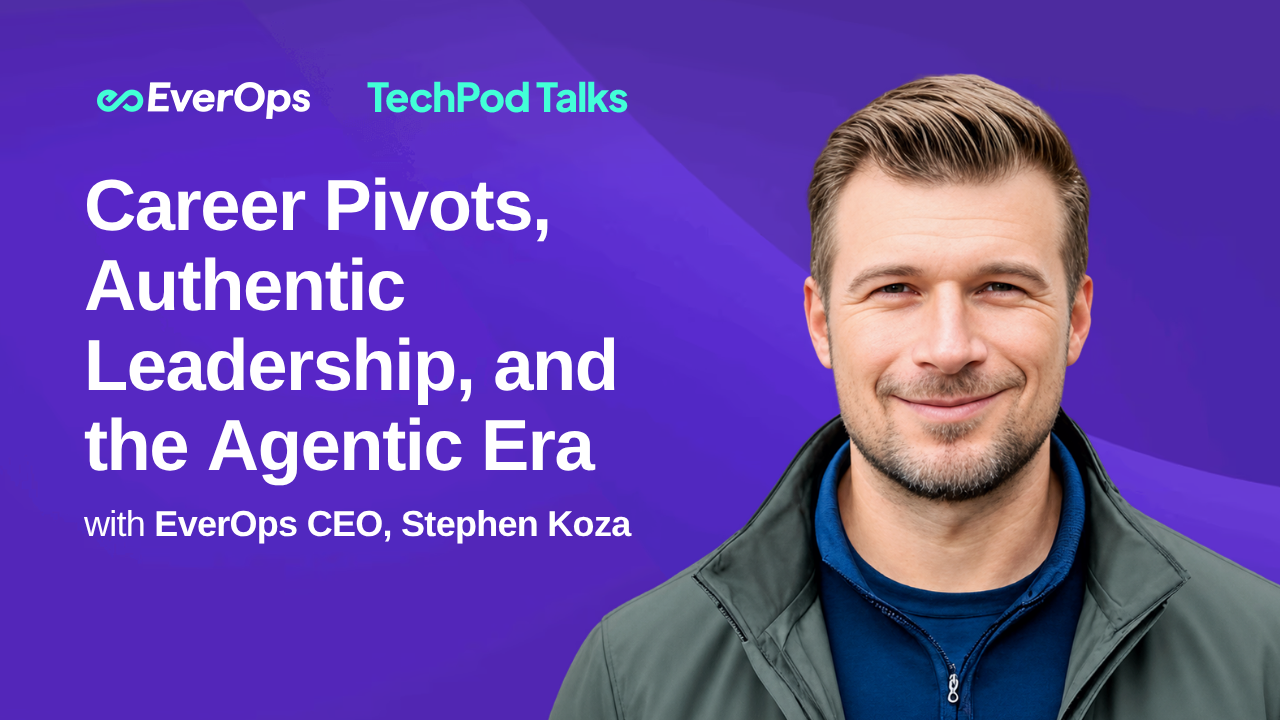
TechPod Talks producer Lauren Dort turns the mic on host Stephen Koza, CEO of EverOps. Stephen traces his path from electrical engineering student at UT Austin to enterprise sales, through Silicon Valley startups and investing, to acquiring and running EverOps since February 2022. The conversation covers what authentic leadership actually looks like in practice, how to hire for ceiling rather than credentials, why most companies are failing to get ROI from AI, and what it will really take before production systems can run autonomously.
Main Topics Covered
- What the squiggly career path actually teaches you, and why putting too much pressure on early-career planning often works against you
- How to maintain credibility with technical teams when you are not the most technical person in the room
- Why caring is a leadership behavior, not a personality trait, and what it looks like when someone actually does it versus just says it
- The difference between hard to work with and toxic, and why conflating the two is a costly leadership mistake
- The rising star hiring profile: what to look for in candidates whose ceiling far exceeds their current credentials
- Why most AI initiatives are not making it to production, and what companies need to get right about data and infrastructure before the agentic era delivers real returns
Links & Resources
- Connect with Stephen Koza: LinkedIn
- Connect with Lauren Hochman Dort: LinkedIn
- Connect with EverOps: Website | LinkedIn
References
- Radical Candor by Kim Scott
- What You Do Is Who You Are by Ben Horowitz
00:00:08- 00:00:30 Lauren Hochman Dort
There's a version of a career that looks like a series of accidents from the outside until it suddenly doesn't. An electrical engineer who pivoted to sales, spent years in enterprise hardware and managed services, landed in Silicon Valley, caught the startup bug, became an investor, and ended up as a CEO not by founding a company, but by acquiring one.
00:00:30 - 00:00:55 Lauren Hochman Dort
Today's guest calls this a squiggly path, which might be underselling it. The through line was always there. He just couldn't see it from the middle. Welcome to TechPod Talks, candid conversations with leaders building what's next. I'm Lauren. And yes, today I am interviewing the host of this very podcast. For those of you who listen regularly, Stephen usually sits in this chair, asks the questions and keeps everyone honest.
00:00:55 - 00:02:22 Lauren Hochman Dort
But not today. I've known Stephen since our days at Cisco Meraki, which means I have both the context and, let's call them, the receipts. Every episode he brings in a practitioner who's actually in the arena to share what's really happening in platform engineering, DevOps, and cloud today. Stephen is that person and he doesn't get to redirect the question. So Stephen has one of the less predictable career paths we've seen in technology leadership. And it makes more sense the further back you look. He started by studying electrical engineering at UT Austin, took his first job as an engineer, and then lobbied his way into sales about a year in because he realized that's where he actually really wanted to be. He spent the next several years in enterprise sales and leadership, which eventually brought him from Texas to San Francisco and into the kind of where coffee shop conversations revolve around term sheets, rather than just earnings calls. He joined a series of fast-moving technology companies, one of which was acquired by Cisco and another of which went public. And he's described those years as an MBA in entrepreneurship. After that, instead of founding a startup the way most people in Silicon Valley would, he started an investment firm, found the right company, put capital into it, and joined as CEO. He's been building EverOps since February 2022. Stephen Koza, welcome to TechPod Talks.
00:02:22 - 00:02:30 Stephen Koza
Wow. Lauren. Quite the intro, except that part about the receipts. Maybe you keep those to yourself.
00:02:30 - 00:02:33 Lauren Hochman Dort
Maybe we'll see how the rest of the conversation goes. We can make a call on it.
00:02:33 - 00:02:44 Stephen Koza
Okay. Fair point. Fair, fair. Well, thanks for doing this. It's nice to not have to prep for one of these. I just show up and hopefully do a good job of answering your questions.
00:02:44 - 00:02:50 Lauren Hochman Dort
Yeah, I know this will come easy to you, so it'll be fun. Are you ready to dive in?
00:02:50 - 00:02:52 Stephen Koza
Of course. Let's do it.
00:02:52 - 00:03:27 Lauren Hochman Dort
All right, so you've talked publicly about something you call the squiggly path. This idea that early career people put way too much pressure on themselves to have it all figured out. You've used your own career as an example, but looking back, you weren't just wandering. You went from electrical engineering to enterprise sales in Silicon Valley and then to startups and then investing to CEO. So each step builds something the next one really needed. So what was actually driving you underneath all of that? And when did you first realize the squiggly path had that through line?
00:03:27 - 00:05:36 Stephen Koza
Well, I don't know what I've said. Squiggly, I'm sure I have. It was probably somewhere along the way. A recent example — I had some undergrad interns working with me when I was full-time investing, and one of them went to the University of Texas, which I love, because I went there, and he came from this family that I could just tell put a lot of pressure on him and his brother. And we had this conversation about how he's going to try and graduate in three years, and he's got like the whole thing mapped out. And I remember telling him, pump the brakes, buddy. Like, college is going to go fast. And I don't think you're not going to win a lot of points for yourself, for your life by like trying to get through fast and like jump into the first thing. But the conversation really was about his career plan and I thought back. Like, what's that? I didn't have one of those when I was in college. What I did is I took a job, was fortunate to have a few offers to pick from. It was an engineering job. I wanted to be in the business side, but they hired me anyways. That's a different story. So the thing I took away from the conversation with this guy was, I think it's really easy to put a lot of pressure on yourself and think that you've got to have it all figured out. You know what step one, two, three is. But in reality, most people don't do that. And you hear these. There's tons of stories. I know anesthesiologists that are now entrepreneurs and own chains of wellness clinics. And you hear stories about lawyers that end up hanging up the law degree. And so, with a few exceptions, maybe medicine being a good one because you kind of got to commit to that path, my advice is always give something a try. If it doesn't work, you can pivot. You can change. So that happened to work out for me mostly. So that's where I get that philosophy.
00:05:36 - 00:05:52 Lauren Hochman Dort
Yeah. Makes sense. And I think it's — we have this need and this drive, whether it's from family or just innate or we feel like it has to all be figured out. We need to have that crystal ball. So very good point. But it doesn't have to all be figured out, especially not right away.
00:05:52 - 00:05:58 Stephen Koza
I don't have it figured out still, so. And I think I'm doing decent.
00:05:58 - 00:06:39 Lauren Hochman Dort
I think you're doing great. Well okay, so one of the pivots I think is hardest to explain from the outside is the move from being a successful operator, companies like Samsara, to actually becoming an investor. And I wanted to discuss that decision a little bit more. So most people who catch the entrepreneurship bug in Silicon Valley default to the founding path. You went a different direction. After Samsara, you start an investment firm rather than a startup. And I guess what I want to know is what made the acquisition model feel like the right bet. And what does investing in a company give you that building one from zero, from scratch doesn't.
00:06:39 - 00:08:11 Stephen Koza
Sure. Well, I'll answer the last part, which is kind of obvious. If you join an existing company, you have most likely customers and products and employees and revenue. And that's pretty nice because building from 0 to 1 is really hard. So I'd love to tell you that I had some, like, grand master plan to do this. I didn't. Squiggly line. But I definitely had the entrepreneurial itch that I wanted to scratch. And through talking to people and networking and learning, I ended up going down the investment path as a means to an end, effectively. I like to say I was an investor for a little bit. Maybe again one day it'll be a full-time thing. Who knows? But it was a way to scratch that itch by joining an operating company, because you still get to do all the entrepreneurial stuff. You get to build and figure it out and, you know, try to get people aligned to a vision and a big picture and goals. And so, like founding a company, it's similar in a lot of ways, easier maybe because of the stuff you start with, probably harder in different ways. But that was the idea. And fortunately it's worked out so far. But I had no idea when I was starting, I was kind of figuring it out.
00:08:11 - 00:12:11 Lauren Hochman Dort
Awesome. Well okay. So I think still on that thought process. If you came into a company that was built and run by engineers with an engineering culture, and your background is fundamentally sales and company building, which you just talked about. But I guess I want to ask you about what the dynamic actually looks like in practice. So I think this is a question that a lot of people might find helpful, regardless of what their exact role is. But you've led technical businesses for years without being the most technical person in the room. You're welcome. Senior engineering leaders often find themselves in a really similar position, so managing deep experts in domains they can't fully code their way through anymore. So they're, you know, getting further from the day-to-day technical work the more senior that they get. So how do you maintain real credibility with technical people when you're not the one who can actually just open the terminal and prove it?
00:12:11 - 00:13:13 Stephen Koza
Yeah, that's a good one. You know, not everybody. Well, there's only one Elon. I'll put it that way. You know, Elon can sit down with an AI engineer and hold his own, just like he can do it with a rocket engineer. And, you know, he's one of one. And so for regular people like me, I think the way to maintain credibility is not to try to be Elon, and admit what you don't know and be curious and ask lots of questions. I will say one thing I definitely did right, or I really value, is the fact that I finished my engineering degree because halfway through I was like, I don't know if I'm going to be the best engineer, but the technical background serves me pretty well. It does not make me super technical, but, you know, sometimes I kind of know what I'm talking about or can kind of understand what's going on. So that's been pretty helpful.
00:13:13 - 00:13:21 Lauren Hochman Dort
Got it. Yeah. Fair enough. You actually have some of the chops from those years of learning and the degree to prove it. So it's awesome.
00:13:21 - 00:13:31 Stephen Koza
I am a very rusty engineer. You know, before AI the last time I coded was C++, and nobody does that anymore.
00:13:31 - 00:14:09 Lauren Hochman Dort
Fair enough. Fair enough. Well, I guess let's shift into what you've actually learned about leadership, because some of what you've said publicly has been specific enough that I would like to ask about it directly. You said you can't be a good leader unless you truly care, and that people can feel authenticity or the absence of it. So I mean, that sounds right, but it's also easy to say, so what does caring actually look like as a behavior? The operational evidence of it, the decisions it changes. Because I think a lot of leaders would describe themselves as caring, and their teams would probably tell you a very different story.
00:14:09 - 00:15:45 Stephen Koza
Yeah, that's a great one. You can't fake it. That's pretty obvious. You know, that shows up really clearly. So I'll tell you how I've tried to approach leadership. First off, I knew nothing about any of it when I got my first leadership role. And so there was a little bit of figuring it out as you go. And, you know, I read a bunch of books and had good mentors and people to model after. And but the best leaders I've always worked for, the ones that I still remember, you could just tell. They just cared. They showed up and they're supportive when you need them to be supportive. And they also don't let you off the hook if you're accountable to something. I think that's pretty important. There's a good book about giving feedback that I know, you know, and probably a lot of people have heard of, called Radical Candor. And the tagline there, or half of the tagline, is care deeply, because it's hard to effectively lead a team and expect people to, you know, follow you into the jungle, or wherever you're trying to go, if they don't think you care and you have a goal that they're aligned with and you're, you know, aware of what's important to them and how you can help them achieve their objectives. And so there's no magic advice for caring. You just have to care.
00:15:45 - 00:16:29 Lauren Hochman Dort
Knowing that you have to actually care. No one can teach you, but people can actually tell when you do or do not. I guess one of the places I think gets tested the hardest is around people who are high performers, but genuinely are hard to work with. So I want to ask you about that. EverOps has a no-jerks policy, and you've said it explicitly as a hiring principal and a culture value. So again, easy to maintain when you have options. But what happens when the person who's a jerk is also your best engineer, or your most critical client relationship? Where does the line actually get drawn? And have you ever had to make the call in real life?
00:16:29 - 00:18:15 Stephen Koza
You know, I'd have to think about an example, and maybe I wouldn't give it to you because I wouldn't want to out somebody. But, you know, culture is pretty important, and culture is this murky, fuzzy word. And, you know, it's not dogs in the office or free food. I think it was Ben Horowitz. Yeah. He wrote a whole book on culture, which was pretty good. So he's one of the partners — his name's on the door. Andreessen Horowitz. And culture is what you do. Culture is the behavior you model. Like, if you're five minutes late for every meeting, it's hard to expect everybody else to be on time. That kind of stuff. And so no-jerks was not my invention. I think we put words to it. But when I joined, one of the things we did was really reflect on who the company is and what is our soul. And, you know, try to put that into words. And so no-jerks has been a tenant since way before my time. And the reason for that is probably pretty obvious. Nobody wants to work with jerks. And, you know, it can be toxic and cancerous and you don't want that. And so we really try to prioritize that when we interview and hire and the way that we run the company. So I don't have a specific person or example for you, other than to say that's got to come first. The rest, you know, you might have a great engineer or somebody that's great at their job, but if they're toxic to the organization, their negative impact far outweighs the positive impact. And that's how you're going to think about it.
00:18:15 - 00:18:26 Lauren Hochman Dort
Makes sense. The ripple effect is very strong. And I think everyone can remember someone difficult or toxic that they've worked with, and that memory lasts. It's a strong one.
00:18:26 - 00:19:39 Stephen Koza
Yeah, I mean, I'll also say that hard to work with and toxic are not the same thing. I mean, they can be in the middle of the Venn diagram, but they're not the same thing. And hard to work with can be improved. And that just comes down to putting it on the table and building enough trust where you can have a conversation with somebody and say, hey, listen, you know, this thing the other day, this is what I experienced and this was the impact, and here's why it's not working, or here's what I'd like to figure out with you. And I have had that happen in the past where there was somebody that, you know, we just butted heads a little bit, and one day we went in a room and talked it out, and we're like best friends after that. It just like some stuff needed to be said. And I didn't totally understand where they were coming from and vice versa. But by the end of it, you know, we really respected each other more and figured out how to work well together. And so that's usually the kind of thing that happens more often than, you know, a real jerk or a toxic kind of situation. Fortunately, at least around here.
00:19:39 - 00:19:52 Lauren Hochman Dort
Yeah. And I think that's where that Radical Candor, the value of it really comes into play, is that you can actually have those conversations so that you are figuring out how to work together, because being difficult typically isn't just one-sided, to be fair.
00:19:52 - 00:19:58 Stephen Koza
Yes, said every married person ever.
00:19:58 - 00:20:45 Lauren Hochman Dort
I'm pretty sure I'm always right. So that's okay. So I want to ask about hiring, because I think this is one of the most practically useful things people could hear who are listening today. So for engineering leaders who spend an enormous amount of time on hiring decisions and get them wrong more than they'd like to admit, you've built teams across Motorola, Meraki, Samsara, and EverOps, and you've talked about prioritizing growth mindset and low ego over hard credentials. So what specifically do you look for that doesn't actually show up on a resume? Like, is there a signal or a question that's reliably told you whether someone is actually the person their application says?
00:20:45 - 00:23:09 Stephen Koza
Sure. Hiring is hard, especially salespeople. They're naturally great interviewers, and so it's especially hard to suss everything out just through an interview process. One of the things I kind of picked up earlier in my leadership journey, somebody else, I think, coined the term and I've now stolen it, is the Rising Star profile. So there were a handful of people I hired who, like, weren't quite ready for the role. They didn't quite have the experience or the credentials or whatever. But through the process, getting to know them, like when this thing is true, you'll see evidence of where they took on some challenge that was above their head. But they rose to the occasion and they were successful. And I love that profile because those people have a very high ceiling. They tend to have a growth mindset. They want to learn, they want to develop. They don't just they're not just open to feedback. They want it. They ask for it. You know, how did that go? What could I have done better? And that's worked out for me. I can name three or four people I hired that kind of look like that, and their careers, you know, since I worked with them, have totally taken off. And, you know, they've got big jobs doing cool stuff. The other one, which is kind of related to this, is I like to understand how people think, and talking about how they solved a problem is a pretty good way to dig into that a little bit. And so when you find somebody that has been faced with ambiguity, or there's not a straight-line answer, or maybe they've had personal or professional challenges, getting to understand how they navigated those and how they approached them is a really good way to understand how people think. What do they do when they're in a jam, they've got their back against the wall. And sometimes it's hard to figure out through, you know, just a few interviews. But that's a trait that I've seen and I try to look for, that I think is pretty valuable.
00:23:09 - 00:23:50 Lauren Hochman Dort
So you mentioned about the rising stars and how some of them have gone on to do amazing things. And I want to talk a little bit about that. So you've mentioned that some people you've hired, you've helped develop, they've gone on to be executives and entrepreneurs. How do you deliberately think about the outcome of actively developing someone towards a role that's bigger than the one they have? You said some of these people come in, they're not quite at the mark just yet. But I'm curious about that because a lot of leaders say they really care about doing that and then kind of quietly resent it when someone actually leaves. So what does it look like when you're doing it on purpose rather than accidentally?
00:23:50 - 00:25:55 Stephen Koza
The way you phrased that was pretty flattering. I don't know if I've developed people. I think maybe I've, you know, given them some sort of platform to go and grow and learn and achieve things, and then maybe some good advice along the way or some support. So I think it's really important to understand people's motivations and what they really care about. And if it is career growth or a bigger title or more responsibility, you get to start with understanding that first. Like if you don't know that about them, it's kind of hard to help them with those things. And you do that just by creating trust and openness and curiosity. And then when you figure out what those things are, you just try to give people opportunities. Maybe it's a new project or new responsibility, or sitting down and understanding what you want to be here in a certain amount of time. And how can I help you with that? And figuring out what those things are along the way. And then the last one you said about resentment when people leave — I've always tried to create an open environment, or at least between me and folks on my team, where if they're not happy or they're not fulfilled or they're chasing something else, like, that's okay, you can tell me. I'm not going to be mad at you. I would much rather help you with that, whether it's with my network or advice or a recommendation letter, whatever those things are. And I think I made a mistake once in one of our all-hands. I said something like that, and some of the people at the company, I think, heard it as me telling them that they should leave. So maybe I didn't say it well enough, but the meaning is the former. Like, I want people to chase whatever they want to go chase, and help them out how I can. And if that's not here, that's okay. I'll help you go find it somewhere else.
00:25:55 - 00:26:16 Lauren Hochman Dort
Yeah. I think that's where going back to you saying about making sure you understand what is motivating someone, whether that's going to help them stay here or not. But I think it's maybe helping them understand that so that you can work with them instead of maybe against them. And that way they are figuring out what they want to do next. Even if they haven't quite figured that out yet themselves.
00:26:16 - 00:26:37 Stephen Koza
Yeah, yeah. I'd probably also say it's hard to do this in practice because, like, business is hard and you got your head down and you've got a million things. And so if I were to be a little self-critical, it would be doing this more frequently and more proactively.
00:26:37 - 00:27:32 Lauren Hochman Dort
It's hard to make the time when you have a million things that all have to be addressed, and you're literally running a business, to make time for it. But listen, I want to ask you one more personal question before we move on to the hot topic of AI, but you've described your life outside of work as beautifully chaotic. Your wife works full time, you have two young, adorable children, you're running EverOps and an investment firm. So what does building something big actually feel like from inside that life? And what keeps it from being just exhausting? Because I think a lot of people describe that kind of load. And what they're really saying is they're not okay, but you can see it in their eyes. So it sounds like you actually mean the beautiful part of the beautifully chaotic. So tell me a little bit more about that.
00:27:32 - 00:29:30 Stephen Koza
I try to just be grateful for things, and that's a pretty good life hack, by the way. You know, there's people at the airport that are grateful they're going somewhere, and there's people at the airport that lose their mind because the flight's delayed, and they yell at the person at the counter because there was weather in another city. And so perspective is pretty important and pretty helpful. So yeah, that's why I say my life is beautifully chaotic or beautiful chaos, because it is chaotic. My wife and I both work. We have a five-year-old and a four-year-old. We've got all the activities, and you know, running a company is pretty consuming. And so I literally just try to be grateful. I'm like, wow, this is like a high-quality set of problems I've got today. There's this great quote, I don't know who it came from, but it's either I'm grateful for the kind of problems I have, and I mean that. And I really believe that I have, on balance, like, pretty awesome problems. And so how do I keep it together? Because, yeah, it can be exhausting. And we've definitely had moments where the stress level is higher than normal. So I try to take care of myself, get enough sleep and work out and don't eat like an idiot. And, you know, carve out the family time and just recognize that the to-do list is never going to get checked off. Like, and you can attest to this, there's stuff on that list that you gave me and you can chase me if you need to. So yeah, that's kind of the attitude — just grateful for the life that we get to live and all the chaos. And it's a season. And you know, one day the kids will be out of the house and I'll be like, man, like, I missed that chaos. That was awesome.
00:29:30 - 00:29:39 Lauren Hochman Dort
I think the quote I like is the days are long, but the years are short. And I think that's a very, to me, accurate way to look at it.
00:29:39 - 00:30:05 Stephen Koza
Yeah. You know, I know quite a few people who have kids going off to college right now because, you know, it's August, and I'm like, wow, like that's a big deal. And I appreciate what a big deal that is for parents. And so I'm like, it's kind of cool to, you know, have this time now and put it. But it'll be here soon.
00:30:05 - 00:30:51 Lauren Hochman Dort
Wild. Which is just insane to think about. There are only five and four. How. But it'll happen. Well, so I want to move on to AI, and I want the unfiltered version. So not just what we would say in a press release or something. So you've said publicly that there's a general consensus that we're still underestimating the effect AI will have on society, and you're not hedging on this. So the AI conversation in tech tends towards the very measured and very careful, lots of well, it depends, and you know, the technology is still maturing, but you're willing to say something much more specific. So what do you actually believe that most people aren't taking seriously enough? And what makes you confident enough to say it out loud?
00:30:51 - 00:34:29 Stephen Koza
Well, I think you've got to define most people, because there's most people in the country, and then I would agree with that statement. Most people in Silicon Valley, not the case. You know, everybody here is a techno-optimist and kind of lives and works in a bubble. And so I try to keep that in mind. So that said, I do think society is underestimating the impact that AI is going to have. I mean, it's going to be like personal computer plus cloud plus mobile plus internet, all wrapped into one, to the power of ten or power of a hundred. And there are a lot of people who understand that, appreciate it, and people who are way smarter than me who have good predictions around this. But I think on balance, like a lot of people are still having their ChatGPT moment. And, you know, that was almost four years ago. And obviously the technology has progressed and evolved really quickly. And the use cases and agents and now robotics, and I mean, I'm pretty pumped. The other thing about AI I would say is — it's somewhat controversial. There was some polling a while back and AI had a lower sentiment or approval rating than the Iran War, maybe, which is kind of crazy to think about. And so you've got to get your information from lots of sources and be willing to question what you hear and question the source. And so there was, and to some degree still is, the narrative around job loss and AI is going to wipe out everybody's jobs. And I wasn't really sure what to believe maybe six months ago. But more recently I'm pretty convinced that's not the case. So you'll have job displacement for sure. Some jobs go away and new ones will be created and jobs are going to change. And I think that's sort of the prevailing commentary now. Whereas months and months ago you had tech leaders talking about, I mean really from the bully pulpit, the whole job loss thing. And they've kind of toned it down now. But if you look at the data, software development is obviously one of the best AI use cases. Software developer job openings are at a three-year high. You've got the frontier labs that are hiring like crazy, and they're obviously pretty good at AI. So there are still — they still need people. And so my opinion is that AI is going to drive a massive amount of economic growth and opportunity because of the efficiencies and the things you can do and create with it. And there's another stat from the other day — companies with high levels of AI adoption are actually hiring faster than companies without that. So I mean, you can tell I'm on the optimistic end of this argument, but man, it's an exciting time. I can't wait to see how things play out over the next few years.
00:34:29 - 00:35:06 Lauren Hochman Dort
Yeah. Well, I guess to that front, one prediction that you've made is something I want to push you on, which is autonomous production systems. You've said companies will eventually run production systems autonomously with AI. And so I want to know how serious you are. Not the aspirational version, but the operational version — where most companies are today relative to that future, what will it actually look like, you know, what breaks along the way? What has to be true about the underlying platform and data infrastructure before any of it can even be real?
00:35:06 - 00:37:26 Stephen Koza
Yeah. Great question. And I'd say I think we'll get there. But as far as the time scale and, you know, how far to the finish line we get, not totally sure. What I do know is companies are not running their production systems fully autonomously today. And that will probably be true for a while. And that's because LLMs are probabilistic, not deterministic. So that's why you ask, you know, your favorite chatbot a question and you might get a different answer each time you ask it. And the thing with production systems, meaning the platforms that host your software and your applications and serve it up to customers or serve it up to your employees, downtime is generally not good. You don't want that. And so if an LLM hallucinates even 1% of the time, or it gives you a wrong answer X percent of the time, you can't have 1% or 5% or 10% downtime. That's not okay. So AI is really good at doing work and automating things, and it's obviously awesome. But sometimes it's wrong. And when it's wrong, it runs off a cliff at 200 miles an hour very confidently. And so that's where the human element is important, and that's where judgment is important. And that's where you need people that understand how to build and architect and run these systems and put the right guardrails in place and make sure they don't run off that cliff. So I think what I've said is I'm not dumb enough to bet against technology. Technology evolves, and AI is evolving faster than any technology revolution we've ever had. And so I think the models will continue to get better and impress us and so on. But will we — are you going to have your application that supports hundreds of millions of users, totally run by agents and LLMs? Probably not. You need some humans around. Make sure that goes well.
00:37:26 - 00:38:04 Lauren Hochman Dort
Yeah. Fair enough. Well, so I mean, you're not just predicting this externally. One of the things is that you're actually betting on this inside your own operations at EverOps. So I want to talk about where that bet has surprised you. So you've been running AI inside your own operations long enough to have opinions that aren't just theoretical. So where has it underdelivered? And, you know, where do you expect that AI to genuinely change how your teams work, and it hasn't yet, or it's been messier than you expected? And what's the assumption you brought in about AI that turned out to be wrong?
00:38:04 - 00:41:09 Stephen Koza
I don't know if I had too many assumptions because, you know, it was all new and novel and I just wanted to learn. So I just started, like everybody else, playing around and hacking and building stuff. So we use it a ton across the business, a bunch of different ways, from sales and marketing and finance and our delivery. Obviously, I think what I've really come to understand and appreciate is it's actually kind of trivial to use AI for something. You know, most companies are piloting different things and trying to make agents work and so on. But something that is not obvious maybe out of the gate is it's really easy to vibe code something, but it is really hard to get that vibe-coded thing into a production app that's stable and secure and doesn't break and doesn't require full-time people to babysit and fix when it breaks. And so I think that's probably a little underappreciated or maybe unknown out there. And the other thing that we've realized working with clients is there's lots of studies and analyst notes on this, but many companies — most are investing in AI and adopting agents and so on. But the majority of those are not getting ROI. They're not making it to production. They're not getting the return that they expected or hoped for. And there's a bunch of reasons for that. Sometimes it's cultural and change management. Sometimes it's picking the wrong use cases, but often it's trying to build on a messy foundation, meaning your data. Your data has got to be organized enough. And not in too many places. And infrastructure, you know, you need all these things like security and governance and guardrails and observability and clean pipelines. And fortunately, that's all stuff that we know a lot about. That's the kind of work that EverOps has done for a decade plus. And so our view of the world is if you want to be successful in the agentic era, you know, moving from chatbots to autonomous agents, your house has to be in order. You've got to build on a solid foundation. And so all the kind of stuff that we've done for years and years just became more important and more critical. It just turns out that it's no longer just to save money or ship your software faster or reduce downtime. All that value still exists, but it's also so you can be ready as an organization to succeed with AI and get the return, and not have to explain to your CFO why everybody's tokens maxing out. And, you know, it hasn't moved the earnings per share.
00:41:09 - 00:41:45 Lauren Hochman Dort
Well, I know we could talk about AI all day, but I do want to close out with something about where you're going personally, not just where the company is going. So before I let you go, I want to hear a little bit more about this. So you've described your career as a squiggly path. I swear it's in writing somewhere. So that path was one that didn't look like it was going anywhere obvious until it was already somewhere. So you're four years into running EverOps, you're also an investor with other bets on the table. What's the thing you don't have figured out just yet, the next decision or next chapter that you're still working at? And what's the next squiggle?
00:41:45 - 00:43:20 Stephen Koza
I mean, there's a lot I don't have figured out for sure. I mean, the journey here has been awesome and there's no end in sight. You know, I'm here for the ride and we've got pretty big ambitions and we're nowhere near those yet. You know, for me, what's next? I have no idea. So I'll go back to the question you asked earlier, which was, you know, the advice and the career path kind of stuff. You always hear that, you know, what is your five-year plan thing? And so I remember this when we did the investment, people asked me for the five-year plan for EverOps, and the answer I gave them was I kind of turn it around. I'm like, can you give me an example of when you had a five-year plan and everything ended up exactly where you thought it was going to be in five years? And everybody got a chuckle, right? So we do have a five-year plan for sure. Like we do all the proper, you know, business planning and strategy stuff. But especially today with the way the market is moving around AI, anybody that can confidently tell you what the world is going to look like in five years is full of, you know what, in my humble opinion. There's probably some really smart people out there that have it figured out, but they are the unicorns, the extreme minority. So we're going to keep building. We are going to catch this AI market transition in a big way. And I'm very confident in that. And, you know, we'll see where it goes.
00:43:20 - 00:43:25 Lauren Hochman Dort
And any personal squiggly paths for yourself outside of work?
00:43:25 - 00:43:40 Stephen Koza
I'm going to run a marathon next year against my better judgment. Yeah, I got arm twisted into that. So I'm excited. I'm excited about that. Not, you know, it'll be good, but that's a next-year problem.
00:43:40 - 00:44:10 Lauren Hochman Dort
Well, Stephen, I've known you since Meraki and I've gotten to watch you work on EverOps and continue to build it. And I've been listening to you interview other people on the show. Getting the personal version of your story was definitely worth the wait. So thank you so much for being a good sport and letting me go through all these questions with you and sitting literally on the other side of it. So if people who are listening, if you want more conversations like this one — and I promise Stephen is a much better interviewer than I am — subscribe to TechPod Talks. You know, wherever you get your podcasts, you can find Stephen and EverOps on LinkedIn. And we have the full episode library on Spotify and the EverOps website. I'm Lauren and thanks for listening.
.jpg)