Episode Description
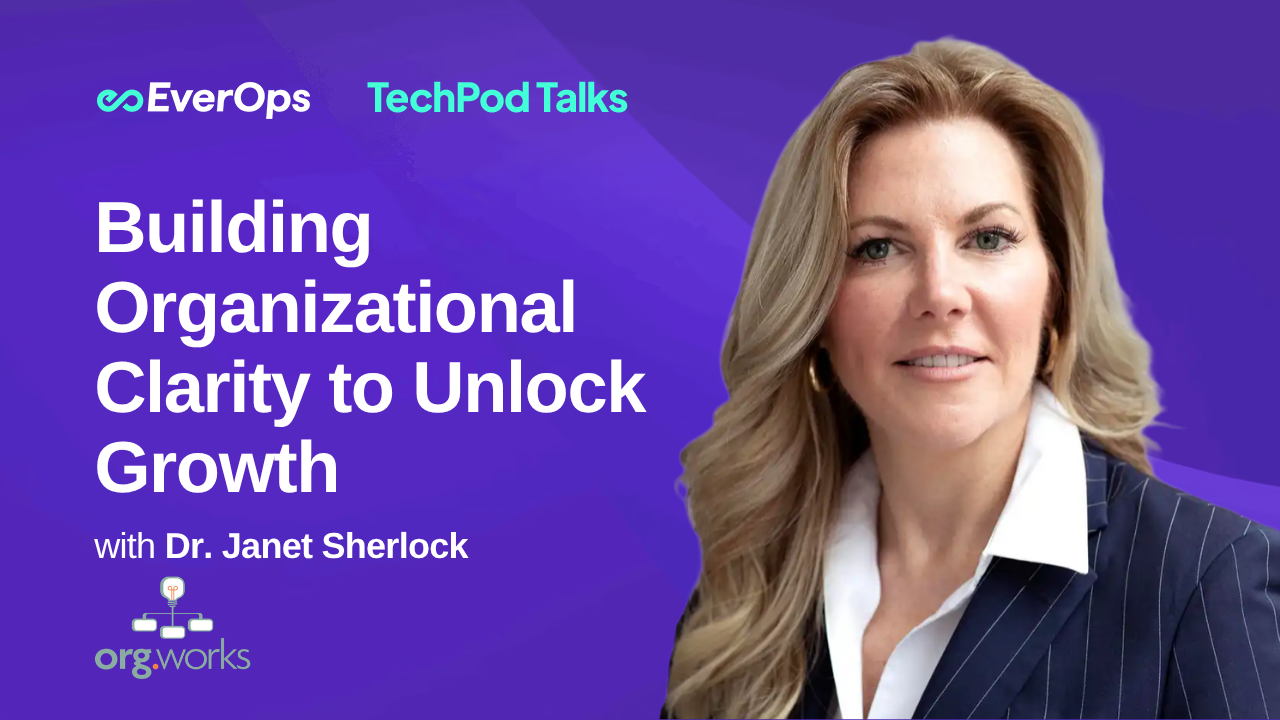
Discover how organizational structure impacts performance, innovation, and growth. Join us as Dr. Janet Sherlock shares insights from her 30-year career, research, and practical experience transforming organizations for the digital age.
Main Topics Covered:
- The overlooked importance of organizational structure in leadership success
- How overlapping C-suite roles and organizational layering impact performance
- The "great flattening" trend among tech giants and its implications
- Strategies for rationalizing organizational layers to improve decision-making
- The role of AI teams within broader organizational structures
- Practical frameworks: the CFD model for AI enablement
- The significance of candor and clear communication in leadership
Links & Resources
Connect with Dr. Janet Sherlock: LinkedIn
Connect with Stephen Koza: LinkedIn
Connect with EverOps: LinkedIn
TEDx Talks: Is your business organized poorly? Here’s what to avoid with Dr. Janet Sherlock
00:00:08 - 00:00:36 Stephen Koza
Most leaders I get to talk to tell me that their biggest problem is hiring or retention or culture, but almost none of them say structure. My guest today is spent 30 years inside the room and has data and some great perspective that suggests most of these other leaders are wrong. I'm excited to introduce her. She has built digital and technology organizations at the highest level of global enterprise.
00:00:36 - 00:01:05 Stephen Koza
She was the chief digital and technology officer at Ralph Lauren, overseeing a multi-billion dollar global e-commerce business. She led the modernization of their technology data processes enterprise wide. Before that, she was the CIO at Carter's and before that led digital and omnichannel at Gartner. So she's got a really interesting background. Her career also includes roles running PNL at gas, Calico Corners, BP, ExxonMobil.
00:01:05 - 00:01:33 Stephen Koza
On top of that, she's got a doctorate in organizational change in leadership from USC, and her research has been cited in boardrooms around the world. She also gave a TEDx talk on organizational clarity. It was recognized as above amongst the 1% of all Ted talks globally. Pretty cool. And now she leads Org.Works, an advisory firm she founded to help companies build structural clarity and unlock growth.
00:01:33 - 00:01:38 Stephen Koza
Please welcome Janet, Doctor Janet Sherlock, it is so great to have you here and see you.
00:01:38 - 00:01:44 Dr. Janet Sherlock
Thank you. Thank you so much, Steve, and I really appreciate being invited to your podcast.
00:01:44 - 00:02:04 Stephen Koza
Yeah, well, pleasure is all mine. You know, you and I met. It was a long time ago. It was a dinner in New York. And I remember just being really impressed. And you were one of those people I tried to make a point of staying in touch with. And we've managed to do that after all these years. And so glad you were able to come on and join and really excited to talk today.
00:02:04 - 00:02:30 Stephen Koza
Well, to start, I'd love to get you talking about your background and your career a little bit. So you started it in and gas at BP and ExxonMobil, then moved into retail. And now you're in the consulting world running an advisory firm. Tell us a little bit about the Arc. What was the thread through all those things, even though the industries have been quite a bit different?
00:02:30 - 00:03:00 Dr. Janet Sherlock
Yeah. You know, when you say it that way, it really sounds like pretty massive pivots. I spent the first 14 years in the petroleum industry, but most of that was actually all of it was downstream. And by downstream it means it's, you know, it's not refining, it's from its retail, retail, you know, gas stations. It is like so it's it is retail, but it is the least sexy sector of retail that you could possibly be in.
00:03:00 - 00:03:23 Dr. Janet Sherlock
And I literally had I wasn't in it to start with. I had every business job that you could have probably in, in downstream petroleum. But, you know, then I took the pivot to after working at a couple of the largest companies in the world to Orca Gas. And there were a lot of similarities, but a lot of differences.
00:03:23 - 00:03:56 Dr. Janet Sherlock
So, you know, the arc, the common arc, the common theme is being in retail. And so it hit me probably, and sometime toward the end of my career at in the petroleum industry. And definitely a guess that this career of taking retail and e-commerce had just started. And technology in making that work, to make teams better, to make companies work better, to make consumer experiences better, that was that.
00:03:56 - 00:04:01 Dr. Janet Sherlock
That became a passion of mine and became the majority of my career.
00:04:01 - 00:04:20 Stephen Koza
Yeah, great. Great point about retail and and gas. And I grew up in Texas. So, you know, a lot of people I went to school with and up going into that industry and, you know, is here upstream, downstream. And yeah, I don't think I actually figured out what that meant until a little while ago.
00:04:21 - 00:04:44 Dr. Janet Sherlock
Yeah. It's interesting now because most of the companies, the big oil companies aren't even in, quote, what we consider downstream anymore. The gas stations that you see in can mean stores that have logos that are branded with petroleum names are not run by petroleum companies, they're run by distributors who run their own chains. So a little different.
00:04:44 - 00:04:49 Stephen Koza
Would you call them franchises or is it less structured? Is it just more of a brand license?
00:04:49 - 00:05:13 Dr. Janet Sherlock
Yeah, it's it's though there are franchises but it in the petroleum industry they work under a different kind of franchise operation. So I'd say most of them either distributors and even the franchisors can be franchises of those distributors. So it's a little different in the petroleum industry than it is in say you know, quick serve restaurants or something like that.
00:05:13 - 00:05:39 Stephen Koza
Yeah. Opening up a bunch of McDonald's or chick fil A's is a little different, right? Well, cool. So just I guess digging into that a little bit, we're going to talk about org design, which I know is a big passion of yours. And I've got a bunch of questions about that. I'm curious, was there a moment early in your career when you thought, wow, this is something I'm passionate about or a problem I want to get better at solving?
00:05:39 - 00:06:11 Dr. Janet Sherlock
You know, it's interesting the later you get in your career, Steven, the more you start to realize just the dynamics that that make organizations and make companies run, and they're usually people related. So I started to notice this phenomenon in the, you know, late 20 tens or early 20 tens through the late 20 tens of this, like proliferation of of technology functions and technology leadership roles.
00:06:11 - 00:06:31 Dr. Janet Sherlock
So I decided and I knew that it was starting to cause like a lot of, you know, friction in a lot of different companies. I was fortunate that I didn't really have that in my case and the companies that I worked for, but I saw it a lot. So I decided during Covid to make some better use of my time.
00:06:31 - 00:07:07 Dr. Janet Sherlock
And I got my doctorate, as you mentioned earlier, from USC, and I specifically studied organization structure and specifically my dissertation. And my research was on the impacts in organizations when there are overlapping C-suite roles and what that actually does. And I went into it thinking it probably had a pretty material effect. Stephen. It was so much more impactful and and negatively impactful than I would have ever thought.
00:07:07 - 00:07:32 Dr. Janet Sherlock
So that then turned into a passion point. So, you know, I decided that I wanted to try to make a difference in corporate America and assist CEOs. Kroes in looking at the importance of their organization structure and the impacts, the material impacts that it has on other companies performance.
00:07:32 - 00:07:54 Stephen Koza
Tell me a little bit about why. So aside from Covid, maybe, you know, some more flexibility or free time or whatever it was. That's a big undertaking. That's a big commitment. I mean, it's a lot hours. You did it while you had a pretty demanding job, I would imagine. What what drove the decision? Why decide to go do that other than just the pure interest?
00:07:54 - 00:08:22 Dr. Janet Sherlock
I had always assumed that I would work on a doctor or PhD. I thought I would do it after I was done, you know, working in the corporate world, and I thought it would probably be something a little bit more consumer centric. You know, I still find the patterns of consumers extremely fascinating. However, I did take advantage of the, quote, extra time.
00:08:22 - 00:08:40 Dr. Janet Sherlock
You know, although we were all working probably twice as much during Covid. But the difference, the difference for me was, you know, I live in new Jersey and I was commuting into the city, so I was literally commuting for over three hours a day. So, you know, between that extra time, I thought I would use it to work out.
00:08:40 - 00:09:04 Dr. Janet Sherlock
That didn't that didn't happen. But I did translate it into something else valuable. Maybe I didn't work out, you know, my body, but I worked at my brain at least. So. So at least I did something positive at that time. So yeah, it was, it was, it was it was really, really rewarding, really enriching. And I'm so, so glad that I did it than I thought I intended to.
00:09:04 - 00:09:23 Stephen Koza
Yeah, I love it. It sounds like a cool experience. I, I thought I was going to go to law school, decided not to probably a good call because I don't think I wanted to be a lawyer, but I always wanted to do an MBA and I never did. And maybe there's a little regret there. Similar motivations. It's just the the subject matter is fascinating.
00:09:23 - 00:09:35 Stephen Koza
I love learning, I love figuring stuff out, but I don't have experience. I guess maybe I'm getting a real world one right now. But yeah, a lot of respect for taking that on. I know it's a lot to juggle.
00:09:35 - 00:09:56 Dr. Janet Sherlock
Yeah, I mean, I do have to say I, I got my MBA a long time ago. I was working when I got that as well. And I still to this day, sometimes I will reflect back to some of the case studies that I worked on and some of the papers that I wrote. They were really educational. And again, that was also very impactful.
00:09:56 - 00:09:59 Dr. Janet Sherlock
So education is a good thing, Stephen, for everybody.
00:09:59 - 00:10:24 Stephen Koza
Well, let's let's talk a little bit about the you know, what you learn doing your doctorate and then throughout your career and what you're now focusing on on the consulting side, let's actually talk about consulting first. So this is interesting because as a senior leader at Ralph Lauren and other companies, I imagine you probably brought in partners to help you with stuff.
00:10:24 - 00:10:50 Stephen Koza
But now you're on the other side now. Now you're running a firm that is the expertise that people call on when they're trying to solve stuff that maybe they need a little help with. You can answer it from both ways, since you've got both perspectives. But how do you think about evaluating when it's time to look for a partner with some unique expertise, versus trying to just push through it on your own, with your own team?
00:10:50 - 00:11:14 Dr. Janet Sherlock
Yeah. That's interesting. I think that when you're thinking about technology teams especially, I think a lot, a lot of leaders frame this up, you know, a little incorrectly and look at it purely as like a resourcing question. Do we have the people or don't we have the people. But it's truly a judgment call about capability, objectivity and you know, the time to value equation.
00:11:14 - 00:11:40 Dr. Janet Sherlock
So I think that there's essentially four conditions that bring whether or not alts at expertise is is appropriate. And the first one is true capability gaps. You know, if you're doing something new, maybe it could be AI, it could be some kind of transformation or something different about your operating model. You know, you might simply not have the expertise internally.
00:11:40 - 00:12:05 Dr. Janet Sherlock
So when you know, this is especially the case when you implement new systems or new platforms, you know, a new ERP or something like that, it Ralph Lauren, whenever we first implemented our e-commerce platform or when we implemented our first or our first, we implemented our enterprise digital asset management solution. We had to rely heavily on external resources because we didn't, you know, we didn't possess them.
00:12:05 - 00:12:31 Dr. Janet Sherlock
And so until you build that knowledge in that muscle, sometimes you have to rely on others. The second one is objectivity and independence. And sometimes you need this when you need a really objective opinion. Like so say it's like, you know, an RFP or, you know, some sort of a system selection process, you know, sometimes history or politics or people with different opinions or biases can, can influence.
00:12:31 - 00:12:55 Dr. Janet Sherlock
And you need a third party. And then to your point, things where like organization design that are maybe sensitive or confidential and, you know, like you said, I can tell you firsthand that that's can be the case. You've got to be, you know, careful with sometimes, you know, letting your internal teams make some of those organizational decisions sometimes.
00:12:55 - 00:13:27 Dr. Janet Sherlock
Well, sometimes they don't. The third I would say is, is speed. You know, there's sometimes moments or deadlines just or, you know, some sort of strategic shift where you just don't have the luxury of time and you need that external support or expertise to accelerate execution. So, you know, just to help you get beyond the finish line. And then the last one is, is based, I'd say really upon value.
00:13:27 - 00:13:57 Dr. Janet Sherlock
So it's, you know, not necessarily about capabilities or objectivity, but it's more about having like an effective resource mix. And that could mean leveraging offshore teams or contractors, you know, or specialized partners that can help you to work more efficiently. So, you know, it's not about just labor arbitrage. It's about being intentional about where and how work gets done so that you can have your highest value talent working on the most important things.
00:13:58 - 00:14:24 Dr. Janet Sherlock
But on the other side of it, I'd say we're companies get into more trouble, Steven, is when they default to using external help for things that they should own, you know, like strategy, decision making and core capabilities. And you need an you need enough internal knowledge to actually run things. You know, there's a lot of companies out there that leverage third party so much to run everything.
00:14:24 - 00:14:48 Dr. Janet Sherlock
You know, I walked into those kinds of situations myself or no one in it knew how things worked end to end or even function the function. And, you know, that's dangerous. So, you know, the goal isn't to outsource everything. It's to. It's to augment your team without abdicating accountability. So I think there's a right way of looking at when to use external resources, thinking about the mix.
00:14:48 - 00:15:01 Dr. Janet Sherlock
And I just I love that you asked the question because it's so important to think about who is doing the work. It's so critical for no technology departments to be able to deliver these days.
00:15:01 - 00:15:37 Stephen Koza
Sure. Yeah, I, I first, I can relate to the overreliance on third parties. We we tend to see that and I, I agree with your sentiment on that one. There's a healthy mix and an unhealthy mix. I also like what you said about time to value. So we're in the consulting services business, as you know. And one of the things that we like to say are it's kind of caught on, maybe because it's catchy is there's three keys people bring us in either for competency, which you talked about capacity, which is similar.
00:15:37 - 00:16:04 Stephen Koza
You just don't have the the bandwidth you need. And then the third one is certainty, which is sort of a umbrella way of talking about time to value and de-risking initiatives and having some confidence that, you know, you're going to get the outcome on the timeline and the budget that you want. And, but but you're right. You gotta you gotta you got to build the internal muscle on the right things.
00:16:04 - 00:16:11 Stephen Koza
And, you know, we've we've seen some companies over the years that didn't do that and a number of areas. And it tends to be pretty messy.
00:16:11 - 00:16:41 Dr. Janet Sherlock
And you know, the the internal capabilities now in relation to AI are, I think, even more critical. And I think you're seeing more and more companies realizing that they need to own some of their own destiny. And if you relied upon third party tools, you know, you've got black boxes that you can't explain. You may end up having to over vendor or over, you know, build on too many tools.
00:16:41 - 00:16:49 Dr. Janet Sherlock
So I think that especially when it comes to like core things, I think that companies are deciding that they need to own their own destiny.
00:16:49 - 00:17:32 Stephen Koza
Yeah, sure. Well, when it comes to an org and how they're organized. Do you have an example of where, looking at the structure of that org, whether it's internal, external, different leadership roles, how you have departments, etc.? Give an example of where simplifying the structure or taking away layers, or maybe even just to your point earlier about clarifying or changing ownership and removing overlaps had a positive outcome like drove some productivity got maybe, you know, a team enabled them to to do more without just scaling headcount.
00:17:32 - 00:18:01 Dr. Janet Sherlock
Absolutely, Stephen. So, you know, I have a slightly different perspective on simplifying structure than many others, especially today. Right now, you know, the tech companies and, you know, in some other companies are just aggressively laying off like middle management to flatten the organization. And it's a trend driven by cost, cost cutting and AI integration. And the term right now I think that they're using is it's the great flattening.
00:18:01 - 00:18:40 Dr. Janet Sherlock
So major firms like Meta and Amazon Microsoft Intel Expedia I mean they've reduced mid-level roles to, you know, and their attempt is to streamline bureaucracy. So the instinct is to flatten horizontally that first I recommend looking for opportunities to flatten out a thin vertically first. And that's, you know, you look for those teams that exist between teams, those coordination layers that were created to to bridge two departments that probably should have been talking together all along.
00:18:41 - 00:19:08 Dr. Janet Sherlock
So, you know, a couple of examples would be, you know, if you have a chief, well, that's usually led by a c o, but give a customer experience team that's inserted between a marketing team and a sales team, you know, you need to ask yourself whether you're actually solving a structural problem or whether you've added that layer of overhead and buffer, and then that eventually slows decision.
00:19:08 - 00:19:40 Dr. Janet Sherlock
So these immediate vertical layers are often the the residue of organizational growth that was never rationalized. So they don't typically create a lot of value. Unfortunately they end up absorbing value. So we're seeing that a lot. Another example you're seeing a lot today Steven is AI teams. So you'll have an AI team that's being created that sits between, you know, a technology team and business teams.
00:19:40 - 00:20:12 Dr. Janet Sherlock
It's the same thing so many times that will literally slow down the speed of implementing AI capabilities as opposed to speeding it up. So removing vertical layers, it does more than just reduce payroll. It can shorten decision paths, it accelerates response times. And it's even more important today in the era of AI, the gen AI, you know, and it's interesting because, you know, you talk about flattening the organization.
00:20:12 - 00:20:42 Dr. Janet Sherlock
The middle managers are often the ones that best understand the workflows and processes enough to determine where AI agents can actually work, or that way they can work around value. Sometimes the higher level folks don't know enough about the work of the processes sufficiently, and sometimes the lower level team members have may not have the strategic insights or knowledge to be able to re-engineer processes using agent AI thoroughly.
00:20:42 - 00:21:13 Dr. Janet Sherlock
So indiscriminately just removing that layer of middle management may potentially be one of the most consequential reduction in force mistakes and strategies organizations can make right now. So the way I look at it is I think of try to look at those vertical organizations first, and then then, you know, when you're looking at the horizontal, you should not allow, you know, stacked leadership structures.
00:21:13 - 00:21:39 Dr. Janet Sherlock
That's that sometimes happens as a result of bad practices. Along the way, someone got promoted, someone they wanted a reward, somebody. So those things do need to, you know, you need to look at those things. But those should probably be a little bit more surgical. And and the first attempt should be removing the thin out vertically. There's just more juice there than to just than just flattening horizontally.
00:21:39 - 00:22:00 Stephen Koza
Love that. I've worked at a couple very big companies and I've seen that firsthand. You know. What does that team do exactly? You know, so I get that one. I like what you said about the specifically having an AI team. That got me thinking about it's easy to designate a give somebody an AI title or an AI org.
00:22:00 - 00:22:28 Stephen Koza
But I think AI is so fundamental and so horizontal like, and you need to become fluent in it. All your employees, your company. I saw a friend on LinkedIn. He's a CEO and his his LinkedIn headline is like CEO who hits his clawed code limits before breakfast or something. I just thought that was so clever because the CEO should be doing that, like to to a certain degree, obviously.
00:22:28 - 00:22:50 Stephen Koza
Right. But you can't you can't delegate AI, you can't abdicate responsibility for understanding it. And because AI makes it arguably easier to deploy technology and solve technology problems, the people doing it should be the ones that understand the business process the best. Which was the point I think you were making.
00:22:50 - 00:22:52 Dr. Janet Sherlock
Absolutely, absolutely.
00:22:52 - 00:23:21 Stephen Koza
Staying on the the, you know, organizational effectiveness topic for a minute. And I want to come back to AI because, you know, everybody wants to talk about AI, including myself. I wonder if you could tell me about a time staying on the organizational design topic for a second, where there was an org that was having a hard time executing, and you realize the root cause wasn't actually people or strategy or culture, but it was structure.
00:23:21 - 00:23:28 Stephen Koza
And what did that look like? What had to change to fix it, and what was what was the outcome?
00:23:29 - 00:24:04 Dr. Janet Sherlock
Yeah, I've seen this pattern many times. And it's interesting because I think what a lot of crows don't really realize is that structure is like a prerequisite for culture. Unless you have that right, you're bound to start causing cultural problems. But okay, on the surface there, sometimes with things look like a people issue. Maybe it's missed timelines or inconsistent execution or, you know, frustration or infighting across teams.
00:24:04 - 00:24:35 Dr. Janet Sherlock
But when you look at a little more closely, the signals are different. So in many consumer facing industries, you'll see this a lot, whether it's banking, hospitality, retail. Because what happened this is now going back years, but it still continues through. The consumers started to shift before before our organizations did. So they expected to be able to interact and transact across channels, across platforms.
00:24:35 - 00:25:21 Dr. Janet Sherlock
What we all now know is omnichannel. So throughout my career. I've organized retail teams and digital teams, also e-commerce teams, to be to work together so that they could be more customer focused. Because that is so incredibly helpful. You get faster speed to market unified customer experiences, and you can get you get economies of scale too. So like even an example of those economies of scale in a retail environment are like you can then share across retail in e-commerce, digital assets, or you can build capabilities that leverage both like so you can use the images or product recommendations in store environments and use them in kiosks and point of sale systems or displays.
00:25:21 - 00:25:55 Dr. Janet Sherlock
In a similar vein, I've got another story. Separately from my own experience, I was advising a CEO of of a quick service restaurant chain, and we were talking about the organization of his team, and he was maintaining a separate restaurant systems team, then the team that ran their app and their digital team. So the wheels on the bus, they'll write off of his his segregated team structure when they tried to implement the in-store kiosk ordering.
00:25:55 - 00:26:33 Dr. Janet Sherlock
So you needed the user interface that sort of replicated the app and online, but you needed the underpinning underpinnings of the restaurant technology. So it was they made it harder than it needed to be. They had a disjointed architecture. You know, the different teams that are struggling for control. And all this due to organizational structure. So, you know, as far as like seeing those signs, you know, what are the signs, what are the what are the signals that you might see when you see multiple leaders that are engaging in the same decisions, but no one clearly owns the massive sign.
00:26:33 - 00:26:59 Dr. Janet Sherlock
When you see a duplication of effort with the same end point. So like in the example that I gave with retail and digital, they both have their own QA departments. But you still needed the third QA process to quality assure the final consumer experience on the omnichannel from the unintended perspective. So having all those QA processes was just not sustainable.
00:26:59 - 00:27:22 Dr. Janet Sherlock
So a duplication of effort is one. And then when you see a bunch of teams or a bunch of, you know, pre meetings or high volume of, you know, let's meet to align on this. So, you know, if you're a CEO and you need to have two or more people brief you on the same topic over an extended period of time, you know that's a sign.
00:27:22 - 00:27:34 Dr. Janet Sherlock
So you know, great people and good strategy don't fail on their own. Most of the time they feel because the structure that was around them isn't doing its job.
00:27:34 - 00:27:52 Stephen Koza
Yeah. That's interesting. You got me thinking. You know, it's easy to be a critic. So when I see an app or a software product or something and it's just clunky and it doesn't work well and it's maybe not well designed, maybe there's a different kind of reason, maybe it's structural. That's interesting.
00:27:52 - 00:28:14 Dr. Janet Sherlock
That is very true. It was. And you know, a lot of companies have have gone really far when it comes to this. But, you know, not that long ago you would see even some banks, you could tell that, you know, in different teams programing stuff, you had different, you know, databases running different things. You could you could see it.
00:28:14 - 00:28:53 Stephen Koza
Yeah, I believe it. Well, let's talk about AI a little bit. You know, it naturally comes up in every conversation already has here. But I know you've got some real world experience and adopting it and driving it across an org. So can can you tell me a little bit about that? And more specifically when when you looked at AI investments, how did you get conviction around experimentation to actually investing in it and trying to get it into production and fully adopted?
00:28:53 - 00:29:27 Dr. Janet Sherlock
That's one of the biggest complaints today about AI is things getting stuck in, you know, proof of concepts or experiments. And I think that most companies get stuck in experimentation because they're not organized to convert that into impact, you know? And of course, I'm a little biased because, you know, but I believe that literally org structure is can be attributed to most of AI failure, lack of adoption of, you know, ability to scale it.
00:29:27 - 00:29:56 Dr. Janet Sherlock
Literally. If you end up on peeling back the onion, you'd see that org structure is end up being behind it. So, you know, when you see lots of pilots and lots of activity, but everyone's on their own and following their own direction, whether it's data, technology, creating models, third party strategies, you know, sometimes you know, you still still see excitement, but where it falls off is there's no mechanism to scale.
00:29:56 - 00:30:10 Dr. Janet Sherlock
So there's not alignment, no true ownership and definitive roles and responsibilities. So you end up not not able to create repeatable results. So I have a very specific model, Stephen.
00:30:10 - 00:30:14 Stephen Koza
Yeah. Well you knew I was going to ask. That's coming next.
00:30:14 - 00:31:01 Dr. Janet Sherlock
Yeah. It's called the CFD model. And it's a center of enablement, federated data science and democratize data and insights. So that's center of enablement which is typically within the technology function. They own the platform the data, all the infrastructure governance. And that's what allows companies to be able to build and scale. And then you have federated data science where and we talked about it just a little bit earlier, where the domain expertise sits in the business, and they can focus on their high value use cases, and they can directly tied to the outcomes that are needed for the business to, to, to to succeed.
00:31:01 - 00:31:27 Dr. Janet Sherlock
So, you know, and they use the platforms and the services provided by that center of enablement. And then last is democratized data and insights. So this is where you extend access to data and personal AI tools more broadly across the organization. This is your access to your, you know, the company's GPT and tools for their own personal efficiency and effectiveness.
00:31:27 - 00:31:56 Dr. Janet Sherlock
When you have a structure like this, this creates a flywheel, because now you have people who are empowered with their own in their within their own areas to actually do what's needed for their particular domain. So the center enables platforms and standards. But, you know, teams, business teams deliver business outcomes. That creates your credibility, that creates the demand and that drives the adoption.
00:31:56 - 00:32:23 Dr. Janet Sherlock
So you have a compounding value behind it. So then the big trick then Stephen becomes making sure you have a good governance process, and then making sure that you don't have that center of enablement be a bottleneck. So, you know, you need to have a really good prioritization process. But if you already have a good IT prioritization process intake portfolio management before, if you layer that in, you'll probably be in really good shape.
00:32:23 - 00:32:38 Dr. Janet Sherlock
So that's that is the approach that I leverage with my clients. It's the approach that I used in organizations before. And I'm telling you it it works. It definitely works.
00:32:39 - 00:33:01 Stephen Koza
I wonder, do you have an example of either a business problem or an app where you applied that and like if you don't, I can make one up like a customer service app. I'd love to just understand like what the, the pieces of that use case and that technology roll out look like by the, the three different groups you just talked about.
00:33:01 - 00:33:22 Dr. Janet Sherlock
Yeah. All right. Well so let's use a customer service app. And I'm sorry I'm going to stick with the with an industry that I know retail. So let's say you've got a contact center and they're saying okay well we need to either create an agent and or I'm going to I'm going to I'm going to layer that layer, another piece onto that.
00:33:22 - 00:33:48 Dr. Janet Sherlock
We also want to provide our agents with some online capabilities where they're already prompted with direction with, with different problem solving, with different lookups for orders or, you know, so you want to do you want to make them more efficient within the chair that they're in. And you also want to have them not get as many calls because you're going to have an agent.
00:33:48 - 00:34:20 Dr. Janet Sherlock
So what you would do with that is you would have the leader of that team or their technology sort of leader work with their counterpart in the center of enablement that knows their area of business and supports them with technology already. And you want to look at your options. Is this something that we want to build ourselves? Is this something that maybe we want to leverage our call center application provider and see if they've got something and it really depends.
00:34:20 - 00:34:45 Dr. Janet Sherlock
Or is there something we're already leveraging in the in the organization that we can build this on. That's the way you work together. And then let's just say you do build your own model, your own agent with some of the, you know, one of the big providers out there, let's say then you would, you know, the requirements and the testing and the ownership of that model would be the actual customer service team.
00:34:46 - 00:34:54 Dr. Janet Sherlock
So they could be supported with people from the center of enablement. But that's that's essentially how something like that would work.
00:34:54 - 00:35:00 Stephen Koza
But they're going to own it. They, they needed they need to take ownership, accountability, drive the direction.
00:35:00 - 00:35:21 Dr. Janet Sherlock
Yeah. This is how the model works. And I trust me, like I just skin the surface of that example because, you know, then there's like you know, the model drift and the, you know, the privacy of the of the data and how it works. There's there's so much behind this. But I just gave you like the, the high level of, you know, how that relationship would work to implement it.
00:35:21 - 00:35:34 Dr. Janet Sherlock
But there's a lot more behind it. But that's how I worked it in the past, and it actually has been effective. You're having the people who have the right skill set doing the right things.
00:35:34 - 00:35:58 Stephen Koza
Yeah, that makes a ton of sense. Well, let's let's get to kind of wrapping up here. You've been generous with your time and I really love your perspective. And I think our listeners will appreciate it. You've spent bulk of your career, I think, as a leader and senior leader. So to kind of wrap it up here, let's talk about leadership.
00:35:58 - 00:36:04 Stephen Koza
What's a lesson that you had to learn the hard way that you wish somebody had told you earlier on?
00:36:04 - 00:36:37 Dr. Janet Sherlock
I would say that one of the lessons that I wish I would have learned earlier was that avoiding candor and challenging conversations, that doesn't make you kind. It just makes things worse over time. You know, early in my career, I spent a lot of time, you know, not telling people when something was, you know, not working or when I was frustrated with them or even when I was giving feedback to people on my own team.
00:36:37 - 00:37:06 Dr. Janet Sherlock
I probably, you know, softened it too much or sugarcoated it too much. And then, you know, the message was probably lost. So, you know, while I may have been telling myself that I was being thoughtful or considerate, in reality, all I was doing with everybody was creating ambiguity and literally unhealthy conditions. Ambiguity doesn't help people. It actually, you know, holds them back.
00:37:06 - 00:37:32 Dr. Janet Sherlock
So what I've learned is that clarity and candor, you know, they're a form of of respect. They're being thoughtful. So when you're clear with someone about your expectations, about what's not working or what is working or how your interactions are with each other, you give them a real chance to respond or improve, and you can open up that real dialog about how you can work together better.
00:37:32 - 00:38:17 Dr. Janet Sherlock
So I had a situation with a colleague of mine, a CMO, that I worked with a few years ago, and we had a fairly tenuous relationship, and I was I was I spent a lot of time frustrating. It's been a lot of time being frustrated. And I would complain, you know, to my husband and people outside work. And finally, you know, I sat down with him one on one and I explained, you know, how my perspective on things and how I thought what his perspective was on it and that certain things he would say that had an impact on me or where things were, I felt like he was being, you know, territorial or having
00:38:17 - 00:38:47 Dr. Janet Sherlock
turf or something like that. And. Oh my gosh, Stephen, that conversation literally changed, you know, the arc of our relationship. And like with a completely different working relationship after that. Now not every situation is that easy. Like I have the conversation and boom, this light goes on. But I did it did make me realize just how important it is to bridge those difficult associations and interactions.
00:38:47 - 00:39:20 Dr. Janet Sherlock
And so I apply that very broadly in my workplace environment. And so when employees ask me like, well, why aren't I getting promoted? Or why did so-and-so get that assignment? Not me. You know, some people, you know, will still filter it out. They don't really want to hear feedback. But what I find is that the majority of people do, they value it and they want to leverage it, but you have to provide it to them, I mean, in a really good and constructive way.
00:39:20 - 00:39:52 Dr. Janet Sherlock
So when you're not forthright in your relationships and and your communications and your feedback, you just end up frustrating yourself, hurting yourself, frustrating your colleagues and hurting your colleagues. So now I just think about it very differently. Candor delivered with respect is kind and lack of candor just it's not kind and it's just avoiding it's avoidance. And it does end up creating long term harm over the long run.
00:39:53 - 00:40:01 Dr. Janet Sherlock
So I think it's it's one of the biggest leadership gaps that I think we have today, Stephen, is is is honest candor.
00:40:01 - 00:40:27 Stephen Koza
Yeah, I love that. I find myself saying a lot or asking my team, did you give them feedback on this? And I think so I learned a similar lesson. Maybe not the hard way. Well, I'm sure I know I screwed it up, but I got some training on this at one point, and I read Radical Candor, if you're familiar with that book, which you just summed it up, I mean, and, you know, you don't have to read it.
00:40:27 - 00:40:47 Stephen Koza
Janet just told you what it says, although it's a really good book and I yeah, I definitely screwed it up. But yeah, it's so important and it's not our default mode. Right. You don't want to hurt people's feelings and you want to be nice and you don't want to create conflict or tension. But that's not the the idea.
00:40:47 - 00:41:09 Stephen Koza
The idea is to put stuff on the table and address it and do it in a way where you actually care, like you want to help somebody grow. You want to affect the outcome. And I sitting on it, or I've used this word to softening. You're not doing anybody any favors them yourself or so that's a great one.
00:41:09 - 00:41:18 Dr. Janet Sherlock
Yes. One comes in for feedback in your office and you start chatting about all sorts of different things. You slide in that little bit of feedback and then you finish with something else. They never even heard it.
00:41:18 - 00:41:20 Stephen Koza
Yeah that's right. Yeah. The compliment sandwich.
00:41:20 - 00:41:23 Dr. Janet Sherlock
Exactly. The sandwich.
00:41:23 - 00:41:31 Stephen Koza
Well Janet, this has been fun. Thank you again. Really appreciate it. Tell everybody where they can find you.
00:41:31 - 00:41:57 Dr. Janet Sherlock
Oh, you can reach me. Well, first, you know. Please, Lincoln. With me. I love to have. I love to watch what different people have to say. And I'd love for you to engage with the content that I post out there. So it's, you know, it's just janitor luck. And then I'm also available at Janet at or it's really simple.
00:41:57 - 00:42:05 Dr. Janet Sherlock
There's no at the end, it's just a.org. And I'd love to hear from from anybody who's interested to chat.
00:42:05 - 00:42:19 Stephen Koza
Cool. Yeah I love that website. That's super clever. Not not easy to forget. So we'll put that stuff in the show notes when we release the episode. So everybody has it. This was fun Janet. Thank you again for it.
00:42:19 - 00:42:23 Dr. Janet Sherlock
You are very welcome. Stephen. It's so good to see you again.
00:42:23 - 00:42:24 Stephen Koza
You too. We'll talk soon.
.jpg)