Episode Description
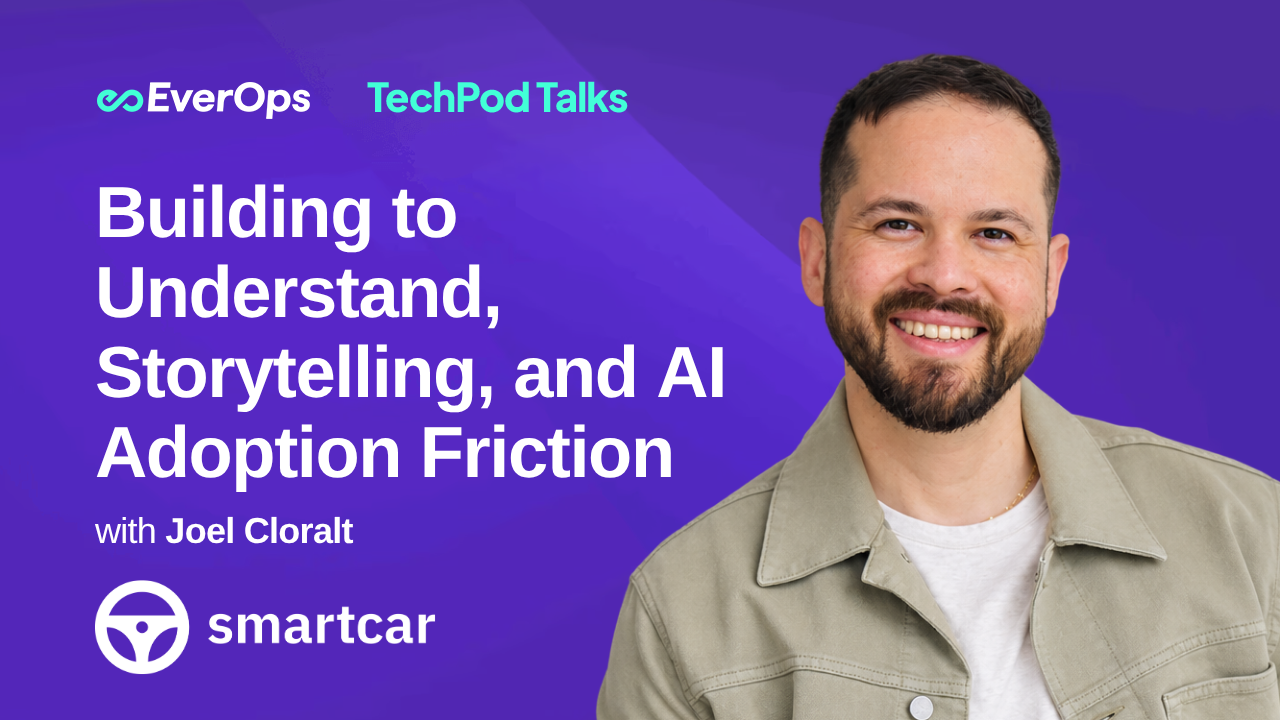
Joel Cloralt is Director of Product at Smartcar, a connected vehicle API platform that helps developers build applications connecting to cars, from routing Uber EVs by battery level to smartly managing grid load when everyone plugs in at 5pm. He's spent 15 years building products across fintech, developer tooling, and connected vehicle tech, all while shipping his own apps on the side. Stephen and Joel get into what it actually takes to make a hard pivot work, why clarity beats charisma in leadership, and where AI is genuinely changing how engineers work and where it's just noise.
Main Topics Covered:
- Leading the B2B to B2C pivot at Vault and the decision-making process that made the Acorns acquisition possible, and how to move on 80% conviction when 100% isn't an option
- Why Joel builds his own apps as a product leader: shipping a Japanese-learning app in Tokyo taught him the difference between what's impressive and what people actually use
- Introvert leadership in practice: why the room doesn't need you to be an extrovert, it needs you to be clear, and how preparation becomes the whole advantage
- Storytelling as an organizational tool: why ideas that travel through a company are wrapped in narrative, not bullet points, and how playing a customer interview video to an engineering org beats any slide deck
- AI at Smartcar: building a developer-facing MCP, making documentation agent-friendly, and the real heavy lift of making sure what the agent responds with is actually accurate
- The underrated skill of knowing when to stop: in product, the effort gets praised, but judgment about what not to build is rarer and worth more
Links & Resources
- Connect with Joel Cloralt: LinkedIn
- Connect with Stephen Koza: LinkedIn
- Connect with EverOps: Website | LinkedIn
Books & References:
- Storyworthy by Matthew Dicks
- The Pyramid Principle by Barbara Minto
- The One Thing by Gary Keller
00:00:09 Stephen Koza
Product Leaders usually go in one direction further away from the code, but closer to strategy, and the general assumption is further up you go. The less time you get to actually build anything. And my guest today has made a deliberate bet against that. He's director of product at a developer platform. He's got apps in the App Store. He's built his own MCP and has a philosophy that shipping your own work is really the only honest way to do the job.
00:00:41 Stephen Koza
So we're going to talk about what that looks like in practice. Welcome to TechPod Talks candid conversations with leaders who are building what's next. Stephen Koza, CEO at EverOps. And my guest today is just the kind of practitioner that we built the show for. He's been building products across some of the most interesting companies in tech for 15 years.
00:01:04 Stephen Koza
He's done it as a product leader but also a builder. Started as a software engineer at a startup. He worked at Yammer that was acquired by Microsoft. Worked on user engagement there. He worked on product at Dropbox. Lived in Tokyo. Started a company there. Built an iOS app to teach himself Japanese. So we're definitely going to talk about that.
00:01:26 Stephen Koza
Join Vault as a product leader, helped them pivot from B2B to B2C. He was there when they were acquired by Acorns. Also spent some time at Netlify and currently at Smartcar, where he leads product for a connected vehicle API platform serving about 20,000 developers. He's got four apps in the App Store, and we're certainly going to talk about that and talk about what the difference is between a good demo and what people can actually use. So Joel, welcome to Tech Pod Talks man.
00:02:01 Joel Cloralt
Thank you so much. It's a pleasure to be here.
00:02:04 Stephen Koza
Yeah indeed man I appreciate you saying yes to this and connecting. And man I'm looking forward to get into it. You got a neat background and I think Japan is fascinating by the way. So I'm definitely going to ask you about that. But let's start a little bit with career arc and some of the places you've been.
00:02:23 Stephen Koza
And we always like to talk about entrepreneurship. So I know I mentioned it in the intro. You led product at Vault, later acquired by Acorns. Tell us about the company. What did you do? And then I know you led the pivot there from B2B to B2C. I'd love to hear about that.
00:02:42 Joel Cloralt
So the idea about Vault was always to bring retirement investment options to the masses. Typically, the workers who have access to these kind of investments are, you know, your typical 401K that comes with your W2, but there's a big piece of the market from, you know, think about the gig economy workers and the rest of the population who are entrepreneurs themselves, who find themselves overwhelmed with the amount of options that there are in the market.
00:03:22 Joel Cloralt
And so Vault was trying to democratize that a bit and offer an avenue for that kind of individual to make investments themselves. So it's definitely a good initiative at the time.
00:03:41 Stephen Koza
So I think the last handful of stops, you've been a product leader, but you started as a builder. So were you coding like what? And then what prompted the career arc and you know, into what you're doing now?
00:03:56 Joel Cloralt
So I think the way I got into product was I there was one time I was in my computer late at night just developing and trying to refactor this, you know, giant piece of code in the app. And I was sure that that was the thing that was going to make the impact, that was the thing that was going to make the difference.
00:04:22 Joel Cloralt
And after lots of, you know, sweats and long nights, I shipped it. And the reality is nobody cared. That wasn't the thing. And I think from that moment forward, I realized the thing that actually matters is really solving the problem for the user, not necessarily how you get there, and really asking why a lot. And so I can relate to my four year old now because I think, like, we have the same thing in common. As a product manager, product leader, you ask why a lot and so does she.
00:05:03 Stephen Koza
Yeah. So I've got a five year old and a four year old and you're not kidding about that. Why is this daddy? Why is that daddy? And so I've learned to appreciate the curiosity, but oh my goodness, there's a lot of those why questions. Nobody told me that. That like, that was a surprise. I didn't see that coming.
00:05:20 Joel Cloralt
Yeah. And so that's a very important quality to have, a very high sense of curiosity. I think, you know, building something on your own, it's also what makes me curious. That curiosity is what makes, what drives me to build something on my own, just so I can understand how things work, how people make decisions. That's another favorite game that we play with.
00:05:48 Joel Cloralt
You know, my good friend Jose, who has been on the podcast before, is, you know, which was sometimes, let's see, some sort of product making a big shift or a big change or announcing a big feature. And, you know, if you remember back in the days, anytime Facebook would do a redesign, people would be like, oh my God. Where did you put my stuff?
00:06:07 Joel Cloralt
I don't like it. And our instinct has always been about asking, well, if you were the PM at that company, what would you do? Right. What do you think went into this decision? Why do you think they made this decision? And so to help us keep that curiosity and bouncing ideas off of each other fresh and gain a different perspective.
00:06:34 Stephen Koza
Yeah. You know, one of the things I've noticed along the way is I so I've been on the business side pretty much all my career. And so I think I've taken it for granted that I tend to appreciate the why behind what we're doing. And what I've realized is a lot of engineers don't ask that question. They don't say, like, why are we, you know, refactoring the code base or what's the purpose behind this initiative?
00:07:04 Stephen Koza
And then if you go a few levels up in thinking or even in an organization and start to connect those dots like, okay, this refactor is going to save us X amount of money, or it's going to enable us to bring features to market faster, or it's going to enable us to build the next set of features that we think are going to make an impact when it comes to the product and the market and adoption or sales or whatever.
00:07:30 Stephen Koza
And I've noticed not all think that way. And maybe because they weren't taught or maybe because they're, you know, kind of heads down on the technical task at hand. And so it was interesting the way you described your transition to product, wanting to kind of scratch that itch and, you know, appreciate that kind of thing a little more.
00:07:49 Stephen Koza
So I thought that was pretty cool. I want to go back to Acorns for a second. So as I understand it, the business did a pivot from B2B to B2C, which is a pretty big deal. I'd say most companies that do that probably don't survive. Like that's a big change. What was behind that and what did it look like?
00:08:10 Joel Cloralt
Yeah. So the B2B and B2C was Vault that was later acquired by Acorns, and that was leading to the acquisition by Acorns. Right. So I think that that's also what made it possible. Yeah. So I think the idea was good and the intentions were good behind the product, but neither of those turned out to be enough.
00:08:33 Joel Cloralt
You know, what we were trying to do was get workers access to investing for retirement and people who weren't being served by anyone else. And that's, you know, a genuinely worthwhile thing to build. And I still think so. But adoption just lagged, right? So I think when funding is limited and you still don't have product market fit, you don't necessarily have the luxury to wait for a good idea to turn into a good business.
00:09:10 Joel Cloralt
And so you have to make a call while you still have runway that you can act on it. And so we went direct to consumers, which meant giving up a version of that vision that we had, the things that we've been rallying the teams around. But it felt righteous, right?
00:09:32 Joel Cloralt
It felt like it was the only route left to actually deliver the thing that we actually wanted to deliver. And so going to consumer is what I believe made the exit possible to Acorns. They were a consumer B2C company, right. And we weren't necessarily in a good position in the shape that we'd been. And so the transformation to get there was, I think, the right one.
00:09:59 Joel Cloralt
It was sort of really checking against ourselves to make sure that, yes, we believe in this new direction. And at the end of the day, it's still a bet, right? That could have not worked out at all. And we're obviously glad that it did. I think we learned quite a bit from it, but time was definitely of the essence. And, you know, we had an amazing team that made it possible.
00:10:23 Stephen Koza
I like what you said about, you know, having to make a call, and I imagine you got to have enough conviction to do it, but you probably didn't have 100% of the information to give you 100% confidence. How much did you have, like, and how do you think about making those kinds of decisions? Because you got a timeline.
00:10:43 Stephen Koza
You can't just wait forever until you can make the perfect call. What was that like?
00:10:48 Joel Cloralt
Yeah. I mean, I remember meeting with the leadership at the time and saying, like, this is, you know, we believe this. Let's call out why we think this would not work and sort of approach it from the risks that we could see and just be okay with the risk that we could not see and figuring those out along the way.
00:11:10 Joel Cloralt
And so now it's maybe 80% sure that this was in the right direction, but there was a whole other 20% that could have just, you know, completely derailed the whole thing. So it worked out.
00:11:24 Stephen Koza
Yeah. That's great. Well, congrats. Those are always the fun ones to talk about. It was cool. Okay, so you also talked about building and you know, the importance of that and doing things on your own or in your free time either for yourself. I think you've got a story there that kind of overlaps your time in Tokyo.
00:11:45 Stephen Koza
And I want to ask you about both so you can take it however you want, wrap it all into one, or we can do that as a two part. But yeah, tell me about building on your own and then what it was like being overseas.
00:11:56 Joel Cloralt
Yeah. I mean, what an incredible experience. To be honest, I feel like I still carry a lot of that perspective of being having the fortune to live in different cities. I grew up in Venezuela and then moved to the States. I lived in Miami, lived in California. Those are already, you could say, two different countries, you know, within the same one, and then Tokyo and now Portland, Oregon.
00:12:30 Joel Cloralt
So very, very different places and cultures and scenes and food. And I think that has allowed me to also bring that and carry that in my career. As I listen to different perspectives and sort of sharpen that curiosity. And I bring that to building as well. I'm very visual. And so I kind of want to see something working, a prototype or an image or something, to actually, you know, hone in the details of what would be next.
00:13:04 Joel Cloralt
Is this possible? And so when I was going to Japan, I was exploring all these different apps, like, you know, I should learn some Japanese, which I have forgotten all of by now.
00:13:17 Stephen Koza
Yeah, that's a hard one as I understand it.
00:13:21 Joel Cloralt
Yeah, definitely a hard one. The apps and the products that I was, you know, sort of using didn't feel right. And to me, I think the luxury that we have now with AI is being able to reduce the cost of building. And so I tried to build something for myself. Back in the day, that wasn't the case with AI.
00:13:44 Joel Cloralt
I just wanted to learn Swift, so I just did that. So it's a lot of Googling back then. But with that, I learned something that I was going to use all the time, and it just helped me with memorization. It's sort of about like, what is an app that can help me, you know, quiz me and repeat and do things randomly so I don't memorize the order of things.
00:14:07 Joel Cloralt
And I just sort of, you know, put it out there and I haven't even updated it. That happened a long time ago. But I see people just, like, download it and use it for practicing the alphabets, if you will.
00:14:22 Stephen Koza
Oh that's cool. How long were you in Tokyo?
00:14:24 Joel Cloralt
I was there for about a year. So I was living in Tokyo. And you'd be surprised how many people speak English. One of my favorite whiskey bars, the owner, I walked in and said, you know, closed door. So I just opened the door and hoped for the best. And this owner, you know, greeted me really well.
00:14:48 Joel Cloralt
And I was trying to speak Japanese. And then he just goes, you speak English, right? And I was like, oh thank God.
00:14:54 Stephen Koza
Oh that's funny. You know what, because I, I'm, I didn't find that whiskey bar or any places like it. My experience, never living there, but been a handful of times or more because I used to travel all over. And most places, at least if you're doing business there, speak English, and not so much in Japan. And then what I found is the people who do speak English won't, because, you know, there's the sense of pride and the culture.
00:15:24 Stephen Koza
And if it's not perfect, you know, so they may understand what you're saying, but just because they're not talking back to you in English doesn't mean they're not listening or they don't know what you're saying.
00:15:35 Joel Cloralt
Absolutely.
00:15:37 Stephen Koza
Yeah. I learned that one. Well, let's shift into leadership a little bit. So you've led teams across a handful of companies. Maybe start with Netlify. You led product across a few verticals. What was your role? What did you focus on? And, you know, how do you think about leadership and outcomes?
00:16:00 Joel Cloralt
At Netlify, it was my now transitioning from fintech to the developer world role, which with a technical background, I felt like I was, you know, just going back home, closer to the coding and the building, if you will. But now I got to sort of shape the experience. I've always felt like there was this part of engineering that because engineers are smart, they're supposed to figure things out.
00:16:32 Joel Cloralt
And so some experiences are like not well-designed, or just, here's a CLI or a terminal and off you go. And Netlify was bringing a lot of these technical products and experiences in a way that makes so much sense and made it more accessible to people without an extensive technical background, while still serving a very technical audience.
00:17:04 Joel Cloralt
And so the fact that you could just grab a folder on your computer and drag it into a website, and all of a sudden you will have your website deployed and you have your own domain, was sort of magical. And as the technology evolves, as all these browsers and web apps started and web frameworks became more widely adopted and more popular, the product kept growing.
00:17:33 Joel Cloralt
And, you know, we went from a few hundred, you know, people, teams under 100 to like over 200 or 300 people by the time I left. So it was a great experience that allowed me to also dive into different parts of the product. So more on the infrastructure side, which I didn't have much experience on, to the more of the user experience that I enjoy, on the design and preview side. So I was able to
00:18:10 Joel Cloralt
work on multiple pillars, if you will. Ended up with a group of PMs who reported to me, as well as the design team at one point and user research. And I felt like that combination was really what some companies try to keep separate. And to me, it was like it was such a natural fit to have that kind of skills working together, just behind the same vision. A well-oiled machine, if you will, is what it ultimately ended up being.
00:18:49 Stephen Koza
So I got to ask you about the infrastructure side, because that's the world we live in. What did you own or what would you focus on? What do you mean by infrastructure?
00:18:59 Joel Cloralt
Yeah. So a lot of the things that Netlify made possible is the ability to allow developers, say full stack developers or front end developers, to run a whole site or app behind the scenes with a back end and serverless functions and things like that, without relying heavily on a developer operations role, which is always a fun debate for people who, you know, like to have that kind of control.
00:19:38 Joel Cloralt
The deploy preview feature of Netlify, which is basically your own staging environment that you can create, was one of the things that I was responsible for. And you can tag on collaboration features to get people to comment and things like that as part of, you know, bringing a site or application to life. That was one of the things that I was working on.
00:20:07 Joel Cloralt
So overall, it's like a product that has now evolved dramatically. I keep following, you know, their progress and their success, and it's amazing to watch how far they've gone.
00:20:20 Stephen Koza
Yeah. But you know, especially nowadays with AI and, you know, more and more code and all the demands around that. So when we were talking before we got on and doing some of the prep, you described yourself as an introvert and I can relate to that. I am too, and I think there's like a spectrum of introvert extrovert and there's probably people that would say, I'm not, but I certainly am.
00:20:46 Stephen Koza
Tell me about yourself. Why do you think of yourself that way? And then how does that show up when you're leading? And sometimes people are expecting you to show up in a room and, you know, maybe be somebody or show up in a way that isn't natural.
00:21:04 Joel Cloralt
I definitely consider myself an introvert. The room in which I'm speaking doesn't need me to be an extrovert. It just needs me to be clear. So somewhere we decided that leadership needs to sound like a particular kind of energy, or most of the leadership I think I've encountered in my career that I actually value was quiet and very specific.
00:21:38 Joel Cloralt
I think preparation is something that turns out to be the entire advantage, after all. You know, as we were talking, I was reflecting on what does it mean to be an introvert? And to me, it's more about being clear. And I gravitate towards storytelling for that reason. Just how can you relate? How can you convey an idea that is something that would resonate and give people a reason to listen?
00:22:11 Stephen Koza
Yeah, I can agree with that. I've come to think about the introvert extrovert thing, at least to me personally, on where you get your energy from. So extroverts tend to want to be like super social and around people all the time and like that fires them up. And that's the one end of the spectrum. And then the other end of the spectrum is like people actively avoid that because it just drains them.
00:22:34 Stephen Koza
And I'm probably somewhere in the middle. I like that kind of thing, but I definitely have a capacity for it. And once the battery is drained, like, I can't function that way anymore. And but yeah, when it comes to leadership, I don't think one end or the other is good or bad or necessary or unnecessary. So I like the way you frame that.
00:22:54 Stephen Koza
And then I also like the storytelling thing. I was listening to this interview with Travis Kalanick the other day, the Uber founder, and he was talking about how he uses storytelling in fundraising and, you know, uses that as a way to convey the mission of the company and what they're trying to accomplish and the opportunity and whatnot.
00:23:17 Stephen Koza
And I thought that was pretty neat because, yeah, that can be pretty powerful in the right room or the right forum.
00:23:23 Joel Cloralt
Absolutely. I think Matthew Dicks is one of the favorite authors I follow for that reason. He has a line that I think about a lot. So he says that when he walks onto a stage, he assumes that the audience despises him, which sounds a little bleak.
00:23:47 Stephen Koza
It's better than picturing everybody naked. I guess that's another hack, right, that you hear?
00:23:53 Joel Cloralt
Yeah, but I think the point is that nobody owes you their attention. You have to give them a reason. And the mistake I see people make, especially as they get more senior, is assuming that the title does that for them. Right. So because you're a director, a VP, people are listening, and they're probably not. They're just quiet.
00:24:17 Joel Cloralt
And those are very different things. So I think the story is something that can resonate with somebody, can carry your idea, it gets retold. And I think to me it's the best way to make sure an idea travels through an org. So when I need something to move, I don't start with like, you know, writing why we should do this, but try to find the moment or something that would resonate with people, something that actually happened to somebody.
00:24:56 Joel Cloralt
Right? So I use examples and I've even played videos of interviews with customers back to the whole engineering org and be like, this is what this person said. And you can hear the person just give us straight feedback about their experience with the product. What better source of material can you get? What better evidence can you give?
00:25:27 Stephen Koza
Yeah. Don't believe me? You know, listen to this guy. He's the one who told me. I love that. That's a good one.
00:25:34 Joel Cloralt
And so I strongly believe that storytelling is one of those pieces that most companies overlook because we gravitate to what's safe. It really pains me when I, you know, see a team preparing for a talk or a presentation and everybody opens, you know, PowerPoint or a Google Slides and starts slapping slides together. Right? It feels like that's what you should do. You're not thinking about what is the takeaway.
00:26:06 Joel Cloralt
What do you want people to take away from this? And what do you want to say? What do you want them to remember? What's the reason for them to listen to anything? And then use the slides for whatever supporting visuals you want.
00:26:20 Stephen Koza
Yeah, that's for sure. McKinsey teaches a way to do slides, which, by the way, is obviously way easier now because you don't have to, you know, pull up PowerPoint and drag boxes around and line stuff up. And, you know, Claude and the other tools are really good at it. But McKinsey teaches a way to do slides, and it kind of is storytelling.
00:26:41 Stephen Koza
The title stands on its own. It's like the main takeaway. And then under that is supporting evidence. And there's a, we'll put it in the show notes, there's like a person's name attached to that, the Barbara Minto method or I'm probably butchering that. But anyways I picked that up along the way. And yeah, you're totally right.
00:27:01 Stephen Koza
Like you can put a whole bunch of junk on slides and hope people read it. But if you have the foresight to think like, what is the message I'm trying to send, what is the story I'm trying to tell? What's the arc throughout that? Because, you know, most people aren't going to read every line or every bullet on a slide, especially if you're presenting it.
00:27:20 Stephen Koza
You don't want them to do that, right. You want to have less content on the slide so you can carry the message and you have the fun supporting stuff as the visual. So anyways, that was that's been useful to me ever since I picked that one. Man, let's talk about AI. You ready for that? You get with that.
00:27:38 Stephen Koza
You're doing a bunch in AI. So you're telling me you built your own MCP at Smartcar? I want to hear about that. But maybe first just tell us about Smartcar. What do you guys do? What are you responsible for there? And then yeah, tell us about the AI investments you're making.
00:27:58 Joel Cloralt
Yeah. The company is about enabling developers to build applications that connect to cars. Cars have gotten a lot smarter. Some people refer to cars as computers on wheels nowadays. And with that comes a whole plethora of software that's behind powering some of these vehicles. And we're starting to see benefits. For example, if you think about Uber, who has a massive fleet of vehicles, one of the challenges with EVs has been driving, you know, somebody taking a ride and then running out of battery midway through.
00:28:52 Joel Cloralt
So it's not a great experience. Charging a vehicle is not as fast as putting in gas really quick. And so how do they map, you know, intelligently, right, to a vehicle that has enough battery in it and to maximize those times? So they use something like Smartcar to connect to the vehicles. And that's one use case, right?
00:29:17 Joel Cloralt
You can think about energy providers and companies to manage the load on the grid. When EV adoption has risen, what happens is everybody leaves work, gets home, plugs in their car, and all of a sudden at 5pm everybody is charging their vehicles, and now there's a heavy load on the grid. And so what a lot of companies are doing is smartly controlling when those cars should be charging through software.
00:29:51 Joel Cloralt
And so Smartcar is one of those companies that makes that possible. So you have use cases like, you know, transportation, energy, insurance, and so on and so forth. So the company itself has built a developer layer to let people build applications on top. It was founded about ten years ago. Think way ahead of the curve there. As cars have gone smarter and smarter, we see the technology changing a lot.
00:30:26 Joel Cloralt
So I joined about three years ago and am responsible for the product, the design aspect of it, and then data analytics, which was a new one for me.
00:30:39 Stephen Koza
So in that role, it sounds like you're responsible for some of the internal AI strategy and you're working on some stuff. What's going on there?
00:30:49 Joel Cloralt
Yeah. And so I mean, obviously the first things that we did was what was very obvious for everybody, which is, well, what AI tools can we give developers to adopt? And so a good learning too, I think, in the early days we figured out that maybe the ability to chat with a bot is, you know, cool, but it's not necessarily that valuable.
00:31:25 Joel Cloralt
That's not how people work. And I think that's some of the things that everybody is still trying with AI, is that there's a lot of impressive things, but impressive and valuable are very different, and they can be different. It's amazing when you have both. But one of those things is the ability to actually change how somebody works and make either, you know, a more productive integration or an easier integration.
00:31:59 Joel Cloralt
One of the things that we tried with this MCP is like, what if you could talk to your car? That sounds cool. I don't think people are doing that kind of thing. Right. So we shifted towards like, well, what are they doing? The pain points that we're trying to solve is integrating with us, right, to get your application quickly out the door so that you can do what's best and not have to think about this kind of integration.
00:32:25 Joel Cloralt
So obviously our documentation and all of that is AI powered. And you can have an agent just, like, go build an app with Smartcar. And there are tools that will enable that. So that's kind of where we are today. And of course, we continue to explore more cool things that I probably can't talk about.
00:32:43 Stephen Koza
Right on, okay, I won't ask you to break confidentiality. But so the MCP, that's customer facing it sounds like, or developer facing, or is that just internal?
00:32:56 Joel Cloralt
This one is developer facing. Yeah, I did do a trial with the customer facing. But again it's like one of those novelty things. And you also have to think about, like, what problem are you trying to solve and the resources you put behind it. At the end of the day, we're a startup. So to put in a whole bunch of, you know, resources to see if somebody wants to tell ChatGPT to lock the doors of their car, it's possible.
00:33:27 Joel Cloralt
Maybe we're ahead of the curve on that one. So we didn't necessarily pursue that.
00:33:34 Stephen Koza
Yeah. Makes sense. Tell me about some of the developer tooling you rolled out. And how do you think about internal AI strategy when it comes to the dev team?
00:33:45 Joel Cloralt
I think, you know, a lot of the misconception is that we're already changing how people work. And in my mind, we're still trying to figure things out. We're in the early stages of early adopters, and even the AI technology itself is changing underneath us. So to give you an example, we built like this AI chatbot.
00:34:14 Joel Cloralt
You can add it to Slack and let people just, you know, ask questions. And nowadays adding a chatbot is more of a commodity. Like, everybody has one because building is not the hard part. I think AI has pretty much solved the building part of it. Our strategy is more about what problems can we solve for developers to get our integration faster out the door?
00:34:47 Joel Cloralt
Not necessarily what kind of data can you pull out of your integration? At least not yet. And so that means, you know, streamlining our SDKs, making sure that our documentation is more agent friendly versus just human, making sure that, which is the hard part also, is making sure that what the agent responds with is actually accurate. It's the piece that sometimes people miss the most, is not necessarily that you have an AI integration, it's what powers the integration, I think, that is the heavy lift.
00:35:32 Joel Cloralt
Making sure that you're not delivering 18,000 water cups, as happened to Taco Bell when they were testing out a drive through powered by AI.
00:35:45 Stephen Koza
Oh that's funny, I hadn't heard that one, but doesn't surprise me.
00:35:48 Joel Cloralt
So they had to roll it back because people like to mess around. So getting the AI in the drive through, probably for Taco Bell, was the easy part. It's just the operations of it and making sure a teenager is not breaking what you build, that is where the hard part is. I think we could save a lot of money in QA if we asked teenagers, you know, to break something.
00:36:18 Stephen Koza
Yeah. Lately I've been seeing stuff on Twitter where somebody's trying to mess with a chatbot, you know, in their Amex app, and, you know, they hit the support button. There's some funny stuff out there, man. There's some funny stuff. So one of the things that I'm hearing a lot lately in conversations I'm having is obviously AI is super powerful and it's going to change so, so much in the world, but we're all kind of wired with a certain set of habits and workflows and business processes, and the easy and often wrong thing to do is just shove AI into them without taking a step back and thinking, okay, I got this new super powerful technology, you know, unlimited intelligence, essentially. What else do I have to change? As opposed to just making it a new step or, you know, a new building block in the flowchart. So what's your take on that when it comes to good habits, bad habits, processes and where AI fits?
00:37:27 Joel Cloralt
I totally agree with the fact that a lot of people are shoving AI into whatever they can, but I think that's history somewhat repeating itself. We saw when, you know, the internet, prior to 2000, everybody was like, well, let's just have a website, and everybody would just create all sorts of things until we sort of started to figure out what's valuable and what's not.
00:37:56 Stephen Koza
So it's like it's like people that would print out all their emails.
00:37:59 Joel Cloralt
Exactly. We saw this with the App Store too when, you know, Apple introduced the App Store and Google introduced Google Play, lots of apps that were just a flashlight on your phone. Fart noises.
00:38:13 Stephen Koza
Well, you have a kid. Those are still fun.
00:38:15 Joel Cloralt
I guess. Yes. But, you know, people started figuring out it's like, oh, your phone has an accelerometer and it has a location. So now we could do x, y, z. And so I think that's what we're seeing now with AI. Right? It's like here's this amazing new technology. What can we do with it? And that's kind of the reason why all these companies are letting people build on top of it, is because new businesses are coming out of it, and some of them are features that get replaced immediately by their own companies.
00:38:47 Joel Cloralt
Right. You saw Apple absorb some of those apps into the operating system. We're seeing the same thing. It even happened to me. I built an app for myself, for grabbing notes and a transcription from a Zoom call or a Google Meet that would generate action items. And that was just like, okay, just give me the action items, give me, you know, anything that I need to do next.
00:39:15 Joel Cloralt
And what happened is, now that's part of, you know, Google Meet. Gemini just automatically does that for you. And I think Zoom is also doing that for you. So it evolves so fast that as soon as I was done building it, it was already part of a native application. So I do think that there is the crowd of let me just add AI and say we're an AI company.
00:39:42 Joel Cloralt
I think that's inevitable. I think those will naturally, like natural selection in a way, as people try to find product market fit. But I do think there were some assumptions that I made that I would probably revisit. I think I assumed that AI would make engineers better at engineering and make them faster at things that they already do.
00:40:11 Joel Cloralt
I think some of that is half true. You know, that's how we get sold. That's how, you know, people frame it and that's how most people talk about it. But what I've also observed is that you can see it in the early adopters: you kind of stop doing the work that you were used to doing, and you become something closer to a manager.
00:40:37 Joel Cloralt
You're directing, you're coordinating, you're reviewing. So the role itself is changing. Your own role is changing. And so, I mean, I don't know if everybody wants that job. A lot of people became engineers precisely because they liked building things. And if you tell them that their role is not doing that anymore, and now you're reviewing what some machine is building, what someone else produced, that may not feel like an upgrade for a lot of people.
00:41:17 Joel Cloralt
So that to me is what I think is causing this adoption friction with some of the AI tools. Something that people value a lot feels like it's being taken away from them. And, you know, maybe it's not irrational.
00:41:36 Stephen Koza
Yeah, I've heard and witnessed that too, because you're right, AI is going to change not every job, but a lot of them for sure. And you know, change is uncomfortable. And people, you know, like sometimes have a little anxiety around the unknown and it's new and it's unfamiliar. And I give you my take. But that's yeah, I'm not sure that it's all that relevant or really matters.
00:42:05 Stephen Koza
But yeah, people's jobs are already changing and I think it's ultimately a positive force. But you know, it's change, and change can always be uncomfortable, that's for sure.
00:42:16 Joel Cloralt
Can be hard for some people.
00:42:18 Stephen Koza
Yeah, totally. Well, let's get to wrapping up here because you've been generous with your time. You know, you've had some cool roles and been through some different acquisitions and like, what's ahead for you? Just think down the road, like, what have you not done yet that you still want to do or experience?
00:42:36 Joel Cloralt
I've always liked to be in this industry because I feel like the knowledge I have can help leverage technology to improve people's lives. I think something where the impact is more maybe physical rather than a cool number on a dashboard. You know, I spend already like what, 15 years asking what would actually change something for somebody. And the answer is that I still want to build a thing where you can point at some change.
00:43:14 Joel Cloralt
So it's not necessarily not looking to move certain metrics and pat myself on the back. I think I want to make a difference in someone's life. And if I can use technology to do that, that's, you know, that's where I'm heading.
00:43:30 Stephen Koza
Love it. Great answer. What's an underrated piece of advice or habit or skill that you've picked up along the way that maybe would be useful to others listening?
00:43:45 Joel Cloralt
I think knowing when to stop would be my answer. Most of what gets praise in the job, especially in product, is in technology, is the effort, the grinding, the shipping, the pushing. Almost nothing is about your judgment about what not to do. And I think it's rare and it's worth a lot. And it's hard at times when there are so many great ideas, you have to say no to some.
00:44:27 Joel Cloralt
And knowing which ones to say no to can be hard.
00:44:32 Stephen Koza
Yeah, I love that one. We had another guest that said something similar, which was focus is knowing what not to do. And the thing I always catch myself saying with folks is, you know, if everything's a priority, nothing's a priority. You can't have five things because like, then you're saying none of them are the most important thing.
00:44:54 Stephen Koza
And I also like the book, The One Thing, which kind of says like, figure out what the thing is that makes everything else easier or more possible. And that's a good way to order lists and think about initiatives and stuff. Where can people find you if they want to connect?
00:45:12 Joel Cloralt
I think the easiest one is LinkedIn, so my profile is public if you want to find me there. I at one point I was at Twitter and then the crowd decided we needed to move somewhere else, and I don't know if I had the time for that. So I tried Bluesky and then dropped it for a little bit.
00:45:33 Joel Cloralt
So I think LinkedIn is probably the one where you will actually find me and I will respond.
00:45:40 Stephen Koza
I'm with you on that one. Cool, man. Well, this has been super fun. I appreciate you coming on and chatting about everything. Thanks again man.
00:45:48 Joel Cloralt
Yeah. Of course. My pleasure. Thank you so much for having me.
00:45:51 Stephen Koza
Yeah you bet man. Have a good one.
.jpg)