Episode Description
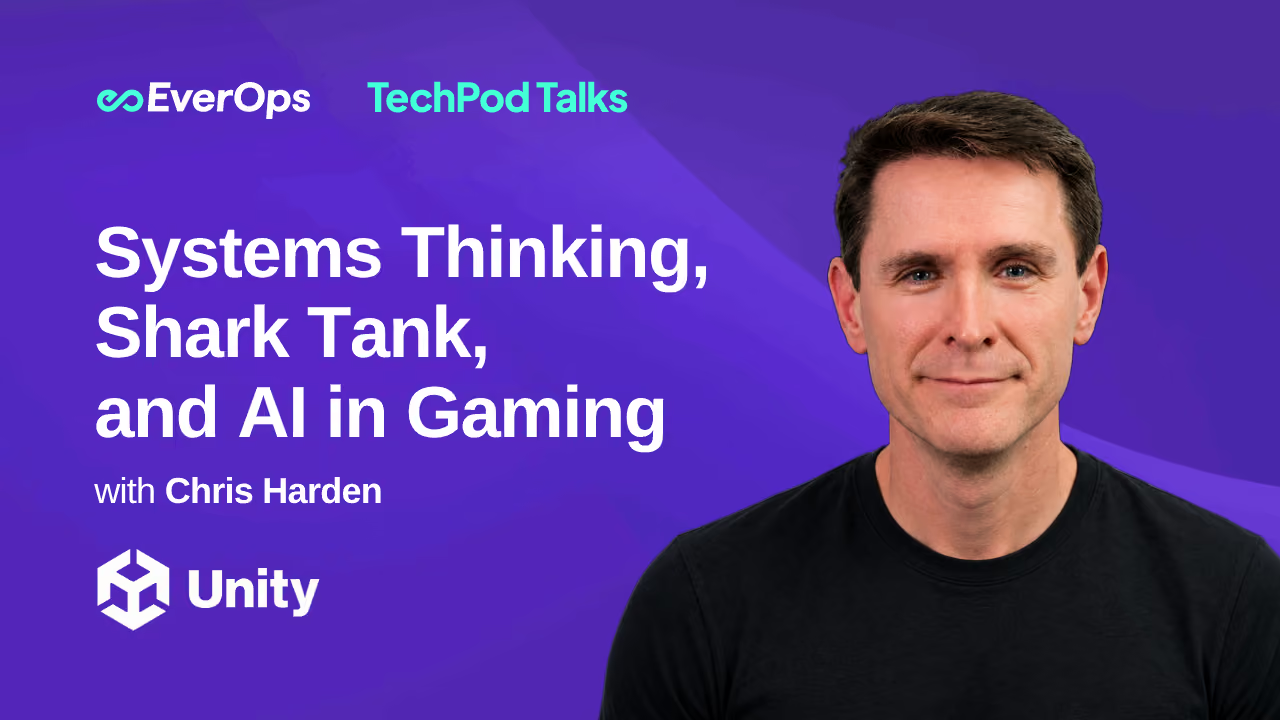
Chris Harden, Director of Production Verification and AI Liaison at Unity, shares how a career spanning theme parks, embedded software, EA Sports, and a startup that was featured on Shark Tank shaped his approach to building the systems around software. He breaks down the AI debate in gaming, how he used agents to write his latest book, and why communication is the most underrated leadership skill.
Main Topics Covered:
- A career built on systems thinking, from programming Epcot control systems to shipping NBA Live at EA Sports to co-founding a Shark Tank startup
- Why the hardest part of shipping a triple-A game isn't the code, it's coordination and integration across hundreds of people
- How Chris uses AI agents at Unity, including a jargon remover, a Scrum Master agent, and a multi-agent workflow for writing his latest book
- The AI and gaming debate: where rapid prototyping wins, where human taste still matters, and why engineers are the orchestrators and verifiers
- Communication as the most common leadership gap, from IC to executive, and why everyone should work in sales at least once
Links & Resources
- Connect with Chris Harden: LinkedIn | Website
- Connect with Stephen Koza: LinkedIn
- Connect with EverOps: Website | LinkedIn
Books Referenced:
- Scale by Geoffrey Moore (systems thinking)
- Crossing the Chasm by Geoffrey Moore
- Little Robot, Big Dreams by Chris Harden (Shark Tank memoir)
- Mastering Commitment by Chris Harden (building trust in teams)
- The 4 Piece Operating Plan by Chris Harden (operating plans framework)
00:00:08 - 00:00:39 Stephen Koza
Engineering leaders spend a bunch of time talking about how to build better software. My guest today has spent his career asking a harder question, which is how do you build the system around the software, the people, the processes, the tools, the communication so the team can actually execute? He's run that experiment at a triple A game studio and a defense contractor, a Shark Tank startup, and now one of the biggest developer platforms in the world.
00:00:39 - 00:01:18 Stephen Koza
Today, I've got Chris Hardin, director of production verification and AI liaison for product and engineering at Unity, which is one of the biggest development platforms behind the gaming vertical. Chris's career is super interesting. He started in sales and to ask him about that and then a project engineer programing control systems for venues like Epcot and Turner Stadium. Then he did embedded software, launching products like the Coca-Cola Freestyle Machine, Ford's infotainment system, and the Kindle Fire.
00:01:18 - 00:01:42 Stephen Koza
Then he got into gaming, spending a few years EA sports, where he led cross-functional teams shipping games like NBA live and then co-founded a startup which is the Shark Tank story. We're going to ask him about now. He's at unity, where he co-founded the Unity Orlando studio. He's built and led engineering teams at the intersection of AI, game development, product delivery.
00:01:42 - 00:01:48 Stephen Koza
And he's also a published author. Chris, hey, welcome to TechPod Talks.
00:01:48 - 00:01:51 Chris Harden
Stephen, thank you so much for having me. I've been looking forward to talking to you.
00:01:51 - 00:02:11 Stephen Koza
Yeah, man. Likewise. So that was a pretty lengthy intro. There's so much that I want to talk about and ask you about, but let's go to the beginning. So I picked up on your LinkedIn. Your first role ever was in sales. And then you hopped into engineering. And I did the opposite, which I think is kind of cool.
00:02:11 - 00:02:34 Stephen Koza
But early in your career, I know you worked on control systems of venues like Epcot, some hardware products that I mentioned. I know like a lot of software engineers and software leaders just do software. They they don't get as close to the hardware as you did. Talk about that. How do you think your background is kind of shaped the way you think about systems and products?
00:02:34 - 00:02:39 Chris Harden
It's really interesting. I actually I went to school for electrical engineering at Auburn, where?
00:02:39 - 00:02:40 Stephen Koza
Eagle. All right.
00:02:40 - 00:03:02 Chris Harden
Where? Eagle. Yeah. The company I joined was Elkhorn McBride. And it was founded by an Epcot engineer. And the Alcorn families don't really well. So I started out really as an electronics engineer doing the hardware design and then also firmware, and slowly went from assembly to see C++ and up the stack over my career and became more of a software engineer.
00:03:02 - 00:03:27 Chris Harden
So the early days of doing hardware design, then of course, understanding software design. It does lead to systems thinking is something you mentioned a moment ago, and there's a wonderful book called scale that was written probably 20 or 30 years ago. And if anyone's interested, a really thin little book that teaches you the mindset of systems thinking, which is great for any later, or entrepreneur for that matter.
00:03:27 - 00:03:49 Stephen Koza
I also did the double track long, long time ago C, C++. Yeah, it sounds like we come from similar era. That's funny. So is there something that you built or programed that you still think about that created kind of a cool experience for the end user?
00:03:50 - 00:04:08 Chris Harden
Yeah. So well, in theme parks, the what what we did was we made a bunch of rackmount automated automation equipment. So we'd go in, it would run lights, it would run doors. It would run audio, video. You could be on a roller coaster and hearing music playing. And this is, you know, Disney's Epcot. It's in museums, Las Vegas cruise ships.
00:04:08 - 00:04:26 Chris Harden
So those that equipment still runs today. It's been built to be rock solid for decades of play, if need be, as long as the venue wants to have whatever level of quality you want. And that used to be like, you know, standard definition, and it became HD and then it became, you know, two K and that kind of stuff.
00:04:26 - 00:04:43 Chris Harden
And so as long as the equipment can still run, it'll keep running the show forever, as long as the company wants it to be running. And so I hope, I believe I probably still have equipment out there running these days in theme parks, not necessarily around the world, but certainly in the US and Europe.
00:04:43 - 00:04:50 Stephen Koza
Yeah. And you're you're in Orlando, right? So you still get to Epcot or any of the other parks?
00:04:50 - 00:05:02 Chris Harden
Yeah, we have annual passes. We go back and forth between Universal and Disney. And so we make it out there quite regularly. And the kids have seen all the parks with the exception of epic. We've got to do that later this year.
00:05:02 - 00:05:23 Stephen Koza
Yeah. Cool. Well, let's jump to a little more. Currently your unity. And I know you're here to talk about tech, not necessarily to represent unity, but like tell me a little bit about, you know, what you're seeing these days and your role and the kind of things you work on and that you're passionate about.
00:05:24 - 00:05:51 Chris Harden
Well, there's two major things that I do at unity. One is I run a program called Production Verification, which is essentially a set of systems that allow our internal product teams, as they're bringing something to market, either for the engine editor or the cloud services, to get access to a bunch of different customers. Because we serve a variety of different customer sizes and make sure that what we're making actually fits those customers needs and we're not breaking something.
00:05:51 - 00:06:17 Chris Harden
But more importantly, if we've got long longevity features like for managing content, is it still living up to what the market needs today, or what do we need to need to change to make it better? So let's go production verification. And we have we have partner companies that we work with. They give us their code. We look at their code and the stuff we're building and make sure that it works well together, and that that serves a large portion of our roughly 4000 people at unity.
00:06:17 - 00:06:46 Chris Harden
And then the other side of my work is in the AI space. I joined the AI team originally six years ago, and have been attached to it in some way ever since. It's evolved a lot, especially since Chatterji beauty changed the world a few years ago, and these days I support making sure that when we go to market with a variety of AI products and our core engine, are they integrating and working well together to serve the customers needs, whether they're one person or enterprise?
00:06:46 - 00:07:10 Chris Harden
I'm not the only person. There's a ton of people helping to to bring these AI native products to market, both on the the engine side as well as the services side, but we do a lot of working with customers. I'm gaming everyday. I'm building something every day with our AI. Right now it's a trading card game just to see what's broken and what doesn't work, so that we can get it fixed before it goes to beta and then out to market.
00:07:10 - 00:07:23 Stephen Koza
Cool. Yeah, that sounds like a fun role. So I know you've been there a little bit, maybe 6 or 7 years. What keeps drawing you deeper rather than chasing something new?
00:07:23 - 00:07:44 Chris Harden
There's a few things. Unity is a good has a good culture. It's a good company. It cares about its people. Considering how large it got. At one point it was around 7000 people. To still have these core values that I actually have on my wall back here and have the diversity and inclusion that the company had at the size when I joined was pretty remarkable.
00:07:44 - 00:08:00 Chris Harden
I hadn't seen that, and I'd been in a bunch of different companies sizes over the years, down from a two person startup, 15, 100 200 people, etc. 1000 people. And so it it kind of blew my mind that it was doable. And that's one of the main reasons why I still work here. People, they care about each other.
00:08:00 - 00:08:23 Chris Harden
They want to work together. The other thing is that a company this large, you can have an entire career here if you want it and you can. You want to stay relevant and enjoy the work. So there's so much to learn. I've yet to learn all the pieces of the tech stack. It's just massive. And so I get technically challenged every week, humbled every month.
00:08:23 - 00:08:32 Chris Harden
I will say it's just what I still don't know, but it's also very much at the forefront of AI for the gaming industry, which I find very compelling and interesting.
00:08:32 - 00:08:56 Stephen Koza
Yeah, sounds pretty neat. I definitely want to talk about AI, so we'll get to that. But you mentioned the career arc. Big companies, small companies. Let's let's talk about the small ones and entrepreneurship. So I know you co-founded a company and there's kind of a cool story there with Shark Tank. And maybe some of the startup accelerators. Tell us about that.
00:08:56 - 00:09:06 Stephen Koza
Like where in your career did that fit and what was the moment you decided to throw caution to the wind and take the leap? Take the risk.
00:09:06 - 00:09:26 Chris Harden
So let's see. I had been a development director at EA and we have a studio here in town. I've been there for a couple of years, I guess, and I'll theme park engineering friend of mine, we worked. We both worked at Elkhorn together years before. We happened to go to a startup event where people were just pitching ideas on the same night.
00:09:26 - 00:09:48 Chris Harden
It was almost, I don't know, preordained. But we started working together on this concept called troppo. And then about six months in, which was as we're getting into summer, we were going to do a Kickstarter, and I was a big fan of Kickstarter. Back in the day. I was watching a menu podcast, reading books, and one of the key tenants was, you really need to be full time if you're going to pull off launching a big kickstart.
00:09:48 - 00:10:05 Chris Harden
And so he had he had actually gone full time into the business because we were part of an accelerator in Orlando. Orlando had a big startup scene at that point, and so he had gone full time. I'd stayed at EA until I could no longer stay, and then when Kickstarter was coming, I said, I finally have to to make that leap.
00:10:05 - 00:10:28 Chris Harden
And I did. And so that summer we launched troppo, which is these little guys here, the little robots that read stories about science and math to kids age 2 to 7. And it was an iPad app connected with Bluetooth to these guys. And so we we got $65,000 on the Kickstarter. And then that funded the way for us to work.
00:10:28 - 00:10:50 Chris Harden
And then we ended up getting an NSF grant, like 250,000, which allowed us to hire a bunch of artists and developers to. And we also outsourced to a team in Kosovo that I was friends with from years earlier. And so it just sort of had this groundswell with Orlando specifically being a huge supporter for us and got us a lot of advertising and support to help land that Kickstarter.
00:10:50 - 00:11:01 Stephen Koza
Wow. That's cool. So you you did the you said the accelerator in Orlando. Did you do others did I did I see I thought I saw some other names, but correct me if I'm wrong.
00:11:01 - 00:11:15 Chris Harden
Yeah we had we had pitched Y Combinator, but we did not get into Y Combinator. That would have been awesome. But they brought us out to California, which is a really interesting little interview and kind of scary. But they were all cool, and it was fun just to be a part of that environment, to see what it was like.
00:11:15 - 00:11:18 Chris Harden
But we did not get invited into our company or Y Combinator.
00:11:18 - 00:11:28 Stephen Koza
So tell me about Shark Tank. I'm sure our listeners want to hear what that's like. What's it like in the room? Like how do you get selected to go on Shark Tank? Walk us through that.
00:11:28 - 00:11:52 Chris Harden
So the selection process can vary. We were actually, I guess, scouted out, if you will, by a producer who was undercover at Toy Fair in New York. We we had the early prototypes on a very humble table, and we were just showing our stuff, and we won like a popular science award, which is really great. And then about a month later, one of the producers contacted us and said, hey, we'd like to have you on the show.
00:11:52 - 00:12:10 Chris Harden
You still have to go through the whole process, though. And so we filled out this enormous, like 45 page contract, and then we started practicing and we did. We shot test videos where we did the pitch in front of the camera. Again, Jeremy was my co-founder and I, we were doing this as sort of a two person show, if you will, two dads trying to make the world better.
00:12:10 - 00:12:31 Chris Harden
And we went through the process. Then we we got invited. We went out to Sony, to their studios in California that day. There was something like, I don't know, 20 maybe different companies that would come in. I can't remember the exact number, but we went in at our slot. We stayed like the green rooms. We went in during our slot, which was in the afternoon.
00:12:31 - 00:12:47 Chris Harden
All the sharks were up there. You can see the whole studio did our pitch and then we didn't know until that was in the summer. We didn't know until that following April that our show was actually going to air. Not and it was two weeks before the show went live. That's how they do it, to keep it secret.
00:12:47 - 00:12:49 Chris Harden
So they don't let stuff out.
00:12:49 - 00:13:17 Stephen Koza
They they keep you on the edge of your seat. It sounds like. That's funny. I could see the appeal of the story. The product seems really cool. There's you know, it. It does a lot of good. And you know, the dads making products for their kids. I, I'm not surprised they would have picked you. That's really cool. Speaking of kids, earlier before we kicked off, you're telling me about summer businesses and something that you've done with your kids to try and teach them some valuable skill sets?
00:13:17 - 00:13:19 Stephen Koza
Talk to me about that. What's behind that?
00:13:19 - 00:13:42 Chris Harden
So every every summer, things starting with the age of five, the kids have done a summer business that's appropriate for their age. And it gets more and more complicated and scales in scope every summer as they can handle more. And so I have a son, he's 14 and my daughter is almost ten here in about a month, and they're each doing either a product sales business or a service business, just depending on their skill sets.
00:13:42 - 00:14:01 Chris Harden
This summer, my daughter is doing a cookie sales business, and besides going door to door knocking and doing the sales conversation, which is scary but possible, we also showed us packaging design, and she'll have a website that we're going to vibe code into place. People can order on the website and and then get the cookie shipped out. So we looked at shifting shipping.
00:14:01 - 00:14:18 Chris Harden
We look at packaging, branding, the financials. All of that would do it for her business and for his business as well. And every summer, the goal is that they continue to reinforce their understanding of how money works in a business, how marketing works in a business, to be confident, doing door to door sales as well, and just build that.
00:14:18 - 00:14:34 Chris Harden
That ability to speak to people confidently and understand how just the whole process of a business works. And ideally, by the time they hit college or after, they've already got ten to, you know, 10 to 15 businesses under the belt, and they can be confident and go out and start their own companies.
00:14:34 - 00:14:56 Stephen Koza
Man, I love that. I've got two younger kids, five and four, just turned five and four. So I was going to ask you, you know, what age you started. So that gives me something to think about this summer. And then I really like what you said about the sales aspect. I think one of the things that's maybe not talked about enough entrepreneurship is sales.
00:14:56 - 00:15:19 Stephen Koza
Like so much of it as sales, you got to, you know, raise money. You got to convince people to come work with you. You got to sell your product. It's my background. I mentioned starting engineering flipped into sales pretty quickly and oh my goodness. It turns out that's a really valuable skill set. And I think finding ways to teach people that because it's not it's not classroom curriculum.
00:15:19 - 00:15:46 Stephen Koza
There's not a book you read and you're like, oh, I get it right. So man, that's super cool. I really love how you've done that. I may borrow some of those ideas from you. Why don't we shift into leadership a little bit? So you've written some books and I know, you know, people love to read books. Not many take the leap and actually go and write them when maybe you can just tell us about some of the books you've written.
00:15:46 - 00:15:53 Stephen Koza
And what I'd love to hear is what was the objective like, what problem were you trying to solve or what did you want to accomplish with writing books?
00:15:54 - 00:16:12 Chris Harden
So it's a it's a great way of expressing ideas and also making you helping you to crystallize your ideas by putting it down into written form. I think everyone knows that, but then also doing it in a way where you have to force yourself to think about the end market you're trying to reach. Will people actually care about this message or not?
00:16:12 - 00:16:39 Chris Harden
Is it just neat? And if you think you can bring a message to people that is different than what's already out there, and they're going to want to read it, it forces you to practice boiling it down to something clear into a package they can understand. And the cool part is that these days it is super easy to write your own book, package it and sell it through Amazon, etc. most anyone who publishes can tell you this is really easy, relatively speaking, to other things to get done.
00:16:39 - 00:16:54 Chris Harden
So I like to do it as often as I can. When I have an idea that just keeps coming back to me, I have one of my whiteboard right now that I've been sort of cooking on for years, but I've yet to get all the nuances right. But one day it'll show up in a book and maybe some sort of curriculum.
00:16:54 - 00:16:59 Stephen Koza
Tell us about some of the books. What like titles? Topics? I'd love to hear more.
00:16:59 - 00:17:16 Chris Harden
I'll tell you my I've got them here, so I'll tell you. My favorite is this actually little little robot, big dreams. It's a memoir from the Shark Tank day. So if you're interested in Shark Tank, that's fun. Just to see what it's like to go from 0 to 1. This one is one of the first ones I wrote and published is Mastering Commitment.
00:17:16 - 00:17:30 Chris Harden
It really talks about how to build trust, and it came from a time when I was working in a company that didn't have a whole lot of trust, and one of my goals was to build that trust. And it led to this concept, which has led to this concept of my wall, which will be broader in the future.
00:17:30 - 00:17:56 Chris Harden
And then this one is one I most recently published. This is a proof which is that laborious, but basically it codifies that most operating plans only had three. There is a fourth piece to it, and these four pieces come together. And if you are trying to figure out how to run a group, an organization, a change management effort, if you have these four pieces that you're consciously thinking of and how they work together, you won't end up with a big gap that bites you later because you forgot something.
00:17:56 - 00:18:01 Chris Harden
And so those four pieces are, you know, people, tools, processes and communications.
00:18:01 - 00:18:11 Stephen Koza
Neat. Any anything specific that inspired that last one? Was there like a project or a career experience that fed into that?
00:18:11 - 00:18:32 Chris Harden
Yeah, as I was actually shaping the production verification program at unity, I needed to teach my team the different pieces of how it all comes together. And they're all they're all really senior in their skill sets, of course, but when you come together with a vision, you could easily miss something because we're moving so fast. And that's true.
00:18:32 - 00:18:50 Chris Harden
It's true for reorg. It's true for any sort of ground up design of something new. And so I crafted that, frankly, as we have teaching them to not miss the pieces. And then I realized after I kept doing it, I was like, this needs to turn into a book that I can give to people as opposed to a scattered set of documents that's on a Google drive somewhere.
00:18:50 - 00:19:06 Stephen Koza
Yeah, that's that's really neat. You know, in terms of leadership, I'm curious, are there any are there any areas you see people fall short over and over that you find yourself coaching or handing them one of these books?
00:19:06 - 00:19:24 Chris Harden
Yeah, I can I can tell you whether it's an I say a mid-level manager less so at the senior level, but it can't happen. Communications. It is a soft skill that you might have heard back even when you were a young engineer. I did engineers come out of school, but they don't know how to communicate. And that is a stereotype.
00:19:24 - 00:19:46 Chris Harden
But it can also be true communications. If you go if you actively think about your internal communications with your team, your external, with your stakeholders in the company and your external with the customers outside, and you're oftentimes thinking about what's good and bad in this situation. What do I have to handle over and over again? What do I need to do to advertise what's going on with my wins or whatever?
00:19:46 - 00:20:09 Chris Harden
Comms is such a challenge. I think the most problematic area I've seen in my career, and this is unfortunately time and time again, is when a reorg happens or a reduction in force is even worse. The comms is so challenging there, and it's oftentimes not handled as well as it could be due to the rush and the need to be private early on the way some people handle yours.
00:20:09 - 00:20:17 Chris Harden
So I say comms hand down, hands down is the one thing that I really dive into on ICI level all the way up to organizational leadership level.
00:20:17 - 00:20:38 Stephen Koza
Yeah, I love that one. I, I want to say it was impressed upon me, you know, in school or earlier in career, but I couldn't give you a I would struggle to give you a specific examples that still like that I hold with me more. So it was I just realized it along the way, like it's so important.
00:20:38 - 00:20:55 Stephen Koza
I couldn't agree more. It's so important to be able to clearly communicate whatever it is you're trying to get across or accomplish, both in written form and verbally. And yeah, I find myself coaching on that a lot. Like Less is More and organize your thoughts. And there's a good way to structure an email in a bad way to structure an email.
00:20:56 - 00:21:12 Stephen Koza
And then we'll talk about AI in a minute. But I think a lot about, okay, is AI going to help us here or is it going to hurt us because, you know, the kids in school that are coming up and, you know, they can just kind of default to AI for a lot of this stuff, but is that a crutch?
00:21:12 - 00:21:23 Stephen Koza
Does it, you know, is it going to keep them from building the skill sets they need? I don't know, I'm curious what like maybe this is a good segue into AI. What are your thoughts on that?
00:21:23 - 00:21:42 Chris Harden
Oh, there's a couple of things I want to dig in. So first up, I'll tell you one of the earliest lessons in good comms that I took away was from my time in sales. I learned about and watched people really excel. When you can simplify it to have the conversation, and you're not having to force this person on onboarding, that takes forever for them to understand what's going on.
00:21:42 - 00:22:08 Chris Harden
So simplified comms actually came from my time in sales. And last forward to to now, I have a jargon remover AI that I give to my team, and there's a couple of folks on my team who is so talented, but their comms can be a little techno technobabble, lots of jibber jabber, or just run on too long. And so this agent, it actually takes PowerPoint decks, documents, emails.
00:22:08 - 00:22:24 Chris Harden
Instead. You just put it in there and it gives you the simpler version. And I've used it in like roadmap presentations where I was handled a pile of these highly technical bullets. And it's like, there's no way this is going to go well, presenting it, give me the clean version. And so I think AI can help. It's just like having a calculator.
00:22:24 - 00:22:37 Chris Harden
You have to know the math before you use the calculator. You have to know what you're doing before you get the right stuff out of AI. But yeah, comms, even simplifying communications, especially if you're a salesperson, I think really helps.
00:22:38 - 00:23:07 Stephen Koza
Yeah, totally. I love that the jargon eliminator agent. What a great use case when you know, when you use the the sales reference there. That actually probably explains a lot where, where and why. I think I picked up the value in that because if you can't communicate well in sales, it's awfully hard. And one of the things I definitely learned, you know, at some point early on is sales and communication.
00:23:07 - 00:23:27 Stephen Koza
It's about being able to connect with the person on the other side of the table. So, you know, if you're talking to them about the features and the speeds and feeds, they may not care about any of that. You know, there may be sitting there thinking, I got a, you know, I got a cost problem and I need to reduce some spend.
00:23:27 - 00:23:51 Stephen Koza
And you know this, I don't care about your feature. Tell me how you're going to solve my business problem. And a lot of that is communication. It's understanding what's important to them, what they care about, being able to put it in their terms, their language, and do it clearly, succinctly. So, you know, I can imagine I mean, the world's going to look a lot different, I think, when my kids are going to college, not I think I know I think we're all convinced of that.
00:23:51 - 00:24:06 Stephen Koza
But sale, you know, a sales career taught me a lot. And even a sales job, I think could, you know, would teach somebody a lot. And I could imagine myself pushing my kids into that, or maybe the summer business idea. I love it because it's just such a valuable skill set.
00:24:06 - 00:24:28 Chris Harden
Well, I would say that everyone should do sales at some point in their life so they understand it, just like everyone should, you know, work in a restaurant or some other services business so they understand that, you know, and that way when you're up there, McDonald's or wherever, you're trying to get a fast hamburger and they're going a little slower, but they're probably struggling because they're new cut on some slack, you know, little insight goes a long way.
00:24:28 - 00:24:32 Stephen Koza
Yeah, totally. Did you have any services jobs when you were young?
00:24:32 - 00:24:41 Chris Harden
Oh, yeah, I my first job was working at Jack's Hamburgers, which I don't know how far that chain is in the southeast, but it's like a McDonald's kind of place.
00:24:41 - 00:25:03 Stephen Koza
Yeah. Cool. I worked at a dry cleaner. Never did. Never did a restaurant? No. No real reason why or why not. But I remember that dry cleaner job. You know, happy people, angry people. You know, why aren't my shirts ready? Too much starch. Same idea. Well, well, let's talk about AI, because I know you're in the middle of it.
00:25:03 - 00:25:24 Stephen Koza
You got a lot to say. I've got a ton of questions. Maybe start by telling me a little bit more about the role you've got today. You said, you know, AI liaison and you're in a, you know, sounds like a leadership role helping the company figure out strategy and use cases and whatnot. Like, what does that look like day to day?
00:25:24 - 00:25:37 Stephen Koza
And then what? Tell me about how you're seeing things change because it's it's fast. You know, every day something's new. We've never seen technology evolve this quickly. Talk to us a little bit about that.
00:25:37 - 00:25:55 Chris Harden
Yeah, it is a bit mind blowing. So the way things have evolved and you can you can kind of see the patterns if you listen a lot of podcasts along the way and you work with it yourself, but the pattern is gone. If you're familiar with Crossing the Chasm, if not, please read that book. But it's your users to your to your listeners.
00:25:55 - 00:26:18 Chris Harden
But the idea of crossing the chasm is at play with AI. And I saw in the early days I wasn't I wasn't the guy who knew had GPT hit, one of my engineers told me about it, and then later I picked up. So it was a little bit later than that. He was. But watching things evolve, I believe now we're actually leaping over this chasm and we're actually on the other side in many ways for these these late adopters that are coming in.
00:26:18 - 00:26:40 Chris Harden
Because now everyone like a year ago, you can still get a lot of great entrepreneurial wins. Do the gap if you knew how to use AI. But man, does that gap slowly, quickly actually trimming down. It's no longer I know how to use something like ChatGPT or even a local agent on my computer. It's now the engineering is.
00:26:40 - 00:26:58 Chris Harden
I know how to make back end harnesses that spin up agents with all the stuff I need automatically, and I can prompt it on GitHub, for example. Or we have our own back end systems that AI that do something quite similar. So the level of engineering has also ratcheted up as even users now, enterprise users in particular, are also making that leap.
00:26:58 - 00:27:17 Chris Harden
So now my team is telling me things about AI that I haven't seen yet, which is wonderful. They all have annual they have annual goals about adopting AI. They use Claude, they use now called desktop, and they have to use it in a game that we make. So their career goals are tied to also using AI and making us faster and doing more with less.
00:27:17 - 00:27:38 Chris Harden
But even they none of them are necessarily AI aficionados, if you will. A couple of them are. But the non engineers they're not. But even they're doing wonderful things like slack integration and Airtable integration. And they're telling me stuff and I'm like we have made it across that leap. Now they're telling me stuff and I can't even keep up with everything that's going on.
00:27:38 - 00:27:46 Chris Harden
But I assess over it and I do as best I can, and there's still too much. So the scale has also left up a lot higher than it was even a year ago.
00:27:46 - 00:27:59 Stephen Koza
It's hard to keep up, but it's pretty exciting. Speaking of agents, I know you. You used agents to help write the latest book. Tell me about that. What did that actually look like and what did you learn from it?
00:27:59 - 00:28:25 Chris Harden
So this was last summer. I used Claude code is one of my favorite local agent interfaces, and I gave it all the documents that I had written instructing these folks on how to write operating plans for the different programs, all run programs. I run programs to fed that to it. I also gave it what became eventually the system prompt, or the instructions for my jargon remover, because I just knew it was going to be a bunch of jibber jabber.
00:28:25 - 00:28:45 Chris Harden
And so I put I basically have a sieve instructions that I give to the agent says, when you're writing this, don't use these words. Just don't use them. Like, what's a good one? I'll come up with a good one in a minute. Don't use these words. It has to be target, you know, a ten year old reader and this kind of stuff and stay away from which jabber, keeping the sentences small, etc. so that was part of it.
00:28:45 - 00:29:06 Chris Harden
There are the documents I said first helped me to create just an outline, and so the agents that I made were a structural agent that said, this is the book structure. An editor, a writer, although the writer, I didn't use as much as you might think, a quote finder, and also someone who would assure quality in the book overall.
00:29:06 - 00:29:22 Chris Harden
So in the early days I would craft it, I had the outline, and then I would go and write the section and pull in some examples, and then it would write some sections, and then I'd run the structure agent through it and it says, hey, you're violating your own rules here. This right here has way too many words.
00:29:22 - 00:29:45 Chris Harden
It's two jibber jabber or it's in the wrong place. You talked about something up here. I don't see it down here. Go back and fix that. And so a lot of the work was working with the structural agent to make sure I had the book in the right order. And I was telling this top to bottom story, and I had a goal of trying to do a five minute, 30 minute and 60 minute version that just never panned out, and it caused me to have to rejigger the book a lot, but the agent would help me get through that.
00:29:45 - 00:30:12 Chris Harden
And then the other thing that was helpful was the research agent that would go and find quotes so I could put quotes at the beginning of the chapters, and then I'd run the other one ago. Is this right? It said, no, Lincoln never said that. Don't put that in the book. So it was a really collaborative effort that helped me to just with verify, help me focus it and write the story at a level that people could read it without taking all their time, but actually have a good top to bottom structure.
00:30:12 - 00:30:30 Stephen Koza
Yeah, I love how well thought out that is. You mentioned you didn't really use agents to, you know, just write the book. What, like where was the gap or where did you decide? Okay, the agents are helpful here. But this part I got to do myself.
00:30:30 - 00:30:49 Chris Harden
Agent I'm sure you know the term AI slob and it's legit. So the agent will be delighted to go on and on and on. If you say I need a 500 word area for this topic, it'll give you 500 words, but it might not make sense. It's very redundant. At some point I had to put prompts in assist.
00:30:49 - 00:31:10 Chris Harden
Quit being so redundant. Don't talk about the same thing up here, up here, up here. I don't need all that lead into all these chapters. I had to go back and clean all that stuff out. So it was a clean read and people were like, why are you telling me this, this little example story ten times so the writing part can get really it can get sloppy and it can get and get really hard to read.
00:31:10 - 00:31:21 Chris Harden
And it's just like, I can't even make my way through the book. So efficiency. You'll need to teach the agents to be efficient, or you'll have to go in and say, just quit putting these sections in because you're just being too redundant.
00:31:21 - 00:31:48 Stephen Koza
Yeah, I believe it. I've I've witnessed that firsthand. We we use agents to prep for board meetings, and I really wish I could just push the button and boom, you know, the 3540 slide board deck is ready to go. And we sent it out a few days before. Definitely not the case, but it is amazing for the outline, organizing, the thoughts, finding, you know, what are we missing?
00:31:48 - 00:31:54 Stephen Koza
What what's not right. But yeah, like, you know, like I end up doing a lot of editing or writing myself.
00:31:54 - 00:32:17 Chris Harden
So it's kind of how it works. It's also true with developing an application that game dev or whatever, you are the person orchestrating the agents. And yes, there are arrangements where an agent will orchestrate other agents for you and all this kind of stuff. But the the most common use, once you get past just to talk into the chat chat GPT is tell us what to do and you verify it over and over again.
00:32:17 - 00:32:20 Chris Harden
And that's you're the orchestrator and the verifier.
00:32:20 - 00:32:44 Stephen Koza
Yeah. Let's talk about AI and gaming. So I know there's there's a debate now tons of great use cases. And then, you know, there's folks that would say, you know, our job is to develop games. And we're not going to hand that off to AI because, you know, if we're trying to produce a hit, you know, converging at the the mean with AI is not going to do that.
00:32:44 - 00:32:50 Stephen Koza
What are your thoughts on just AI and gaming in general, and where do you think that debate lands?
00:32:50 - 00:33:29 Chris Harden
I think there's actually two key debates. The mean is one of it for sure, especially in the the creative aspect of game development, the art, whether it's music, assets, models, you know, that kind of thing. And so that area is high risk. You can you can use the art generation aspects of it. I say art loosely music, all the pieces for the creative side and a rapid prototyping scenario, whether it's your mid journeys, your tripods, whatever the whatever the modeling, the art is that you want to use, you can rapidly prototype quite quickly and see if your game is having fun.
00:33:29 - 00:33:45 Chris Harden
Even though the assets may not be, it won't be what you bring to market. And there's a discussion on that. There's people who who don't care, and they'll take what the assets are given to them. They usually aren't artists. They'll never be an artist in their entire life, and they're delighted to have someone who can do it to actually bring their game to life.
00:33:45 - 00:34:09 Chris Harden
And then there's the the studios whose brand reputation is hinged upon a great game, cosmetics, all that stuff. And so the pushback usually is in the creative side. And that's where the large part of the debate is so usually settles positively in the rapid prototyping space, knowing that your your paid artists and designers, they'll go in and do the actual design work before the game goes to market.
00:34:09 - 00:34:31 Chris Harden
On the engineering side, which is the other half, engineering is is keen to optimize as much as possible. And there are a lot of, you know, successful gaming companies who now want a development. Either it's to migrate a game to the latest version of unity, in our case, to do a port to change some underpinning tech stack, which is just too old and rickety.
00:34:31 - 00:34:57 Chris Harden
There are a lot of efficiencies that engineering can gain from using agents to do all this work with and for them, and even even building new features, and also teaching you about areas that you don't know. You can learn a lot. And working with the agents. The challenge there, though, is you have to really be technically savvy enough to understand what the agent is making and ensuring that it's not giving you slop, that you then have to deal with tech debt for the next 5 or 6 years on.
00:34:57 - 00:35:20 Chris Harden
So there is a risk there. And then there's this. And that's sort of like especially true when you're you're dealing with mature products, mature games, mature tools, and you're putting agents in there and they can wreak all sorts of havoc that you can't necessarily see if you're not careful when you're doing greenfield brand new development. Those teams move super fast because they're just they're just by coding away and bringing something to market, and then they shape it.
00:35:20 - 00:35:33 Chris Harden
And so it's like rapid prototyping but in the engineering stance. And those guys move fast. And you see a lot of that stuff making it to market too. So you kind of depends on your context as to whether or not you can handle and how much of AI you can handle and what you want to say. No thank you.
00:35:33 - 00:35:35 Chris Harden
We're going to let our experts handle it.
00:35:35 - 00:35:59 Stephen Koza
Yeah, I think that's the key one. One thing we talk about a lot is the necessity of judgment. And AI is great at doing work and producing things, and but it's probabilistic. And, you know, when it makes a wrong decision or, you know, the thing you don't want, it runs off a cliff at 200 miles an hour with, you know, supreme confidence on whatever that thing is.
00:35:59 - 00:36:23 Stephen Koza
And so, you know, we think that becomes our value in the AI era. You know, AI does the work. And, you know, we bring the codified patterns and the judgment. And more generally, I think like the humans got to connect the stuff, connect the ideas and the care abouts and the, you know, the make the judgment calls and stand behind them and be accountable for them.
00:36:23 - 00:36:35 Stephen Koza
So I'm really fascinated at everything AI can and will be able to do. But man, I like I don't know about the judgment thing. Like I don't see computers just being able to take that over for a bunch of reasons.
00:36:35 - 00:36:52 Chris Harden
I don't think in the end there's a sense of game taste. Like we talk about that a lot. Unity is this is the designer. They have a taste in the game that they're trying to make. And you know, the AI is just not going to be able to do that. It's not its strength. It's a pairing of the human and the AI that really works best.
00:36:52 - 00:37:16 Stephen Koza
Yeah for sure. I mean, I think about, you know, Apple and why they've been so successful as a product company. And it's because of that it tastes and original ideas and a way of thinking that, you know, if they were just relying on AI models to drive their roadmap, you know, they're they've got something up here and, you know, AI is going to be producing something like squarely in the middle of all the training knowledge that it sucked up.
00:37:16 - 00:37:41 Stephen Koza
And some is good and some is bad. And I I'm pretty bullish on the human judgment thing and taste and creativity for that reason. Let's let's just jump into like getting stuff done. So I know you've been personally responsible for shipping games and building teams to solve some cool problems. What a maybe tell us about a game launch.
00:37:41 - 00:37:50 Stephen Koza
What are the biggest challenges in that? And is there a specific example or game you worked on that you can tie back to?
00:37:50 - 00:38:20 Chris Harden
Sure, yeah, I can I can talk about NBA live 14. So that was that came out of EA here in Tiburon. James Harden was on the covers of basketball game, and it was about 200 people making that game and a bunch of different locations, bunch of different disciplines and a very Triple-A experience. And hands down, the hardest challenge that comes with moving a game that big to market on a timeline, because it launches with sports games, they launch on schedule with the start of the season.
00:38:20 - 00:38:43 Chris Harden
Generally speaking, if they miss it, they may just wait till the next year. So getting that many people to coordinate on a cohesive, a cohesive gaming experience that actually had two tracks, one for street ball, one for NBA, and it had different vibes and all the storytelling and stuff. That's just a monumental effort, to be clear, that's at the executive producer producer level.
00:38:43 - 00:39:08 Chris Harden
Engineering has leaderships. All the verticals have their own teams that they bring to market, and then each of them has different functionalities and that kind of stuff. So it's a monumental effort. But hands down, the most challenging thing is coordination and comms between those groups, making sure that when this team says it's done and that team says it's done really well, let's put it in something called a build review every two weeks and let the producers see that you're done.
00:39:08 - 00:39:24 Chris Harden
Oh, no, you thought you were done, but it didn't integrate with those two pieces, so it doesn't really work. What is done really look like? Oh, this is what done looks like. I'll see you in two weeks. Let's try again. And so that iterative review the feedback the trust. But verify as you call it, it doesn't assume the worst in people.
00:39:24 - 00:39:39 Chris Harden
It just assumes that integration risk is always present. And that's something that often gets missed because no one's really in charge of integration. So coordinating to make sure that everyone's working together and then integrating their stuff is a huge challenge when you're moving that many people to a deadline.
00:39:39 - 00:40:00 Stephen Koza
Yeah. Got it. Well, let me let me finish up here. Just keep us on time with a few closing questions. You've been I love your background. You know, different kinds of roles, different kinds of companies, you know, especially the entrepreneurial stuff. Is there any thread that kind of connects all of those for you?
00:40:00 - 00:40:22 Chris Harden
I think for me, I still don't know what I'm gonna do when I grow up. And so entrepreneurship, I absolutely love entrepreneurship and there's a lot of risk. I also really love making a decent income from my family, and so I tend to go back and forth between the two disciplines of large corporate or maybe even mid-cap, corporate and startup as I can.
00:40:22 - 00:40:42 Chris Harden
And then also like variety, I used to illustrate an ink comic books when I was younger and in college, and so I have a graphic design background. So variety is also really important for me to just sort of keeping it fresh and interesting. I have ADHD, and so this variety is also really important for me to get something different every now and then.
00:40:42 - 00:40:51 Chris Harden
So I think the through line for me is keeping it fresh, while also serving two major needs of having an impact and also making a good income for my family.
00:40:51 - 00:40:59 Stephen Koza
Yeah, I love it. Cool man. Well, where can people find you if they want to check out the books or learn more about you.
00:40:59 - 00:41:04 Chris Harden
Just go to Chris Harden. So Chris Harden.
00:41:04 - 00:41:30 Stephen Koza
Cool. Love it. Well thanks for that. And Chris man this was fun I really appreciate you coming on. Thanks again for the time for everybody listening. Hope you enjoy the episode. We're on Spotify YouTube Apple Podcasts. If you liked it, do us a favor. Give us a rating review like subscribe. It helps with our reach. I'm Stephen Koza and this is TechPod Talks and we'll see you next time.
00:41:30 - 00:41:31 Stephen Koza
Thanks, everybody.
.jpg)