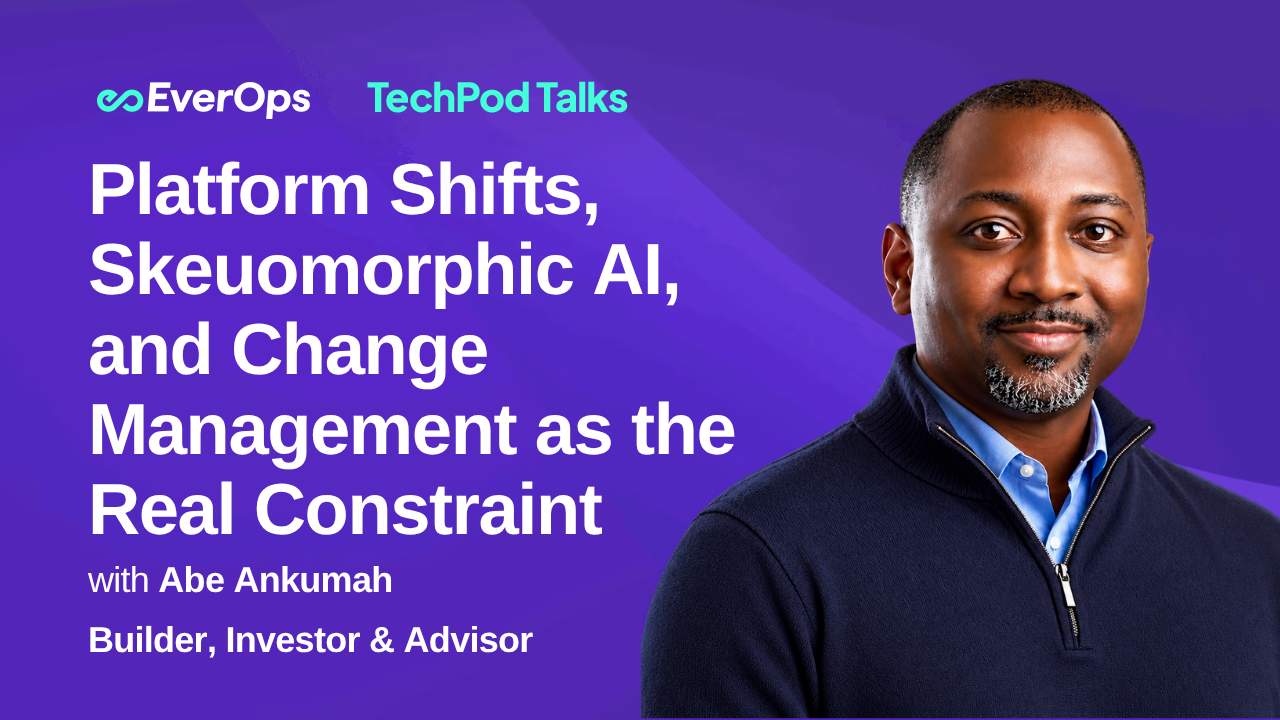
Episode Description
Abe Ankumah has spent his career at the infrastructure layer, building through the internet, mobility, cloud, and now AI. He was part of the founding engineering team at Fulcrum Microsystems working on low latency switching silicon, co-founded and led Nyansa through its acquisition by VMware, then scaled the SD-WAN and SASE business past 18,000 customers as VP and GM before serving as Chief Product Officer at 1Password. He is now investing, advising, and, as Stephen gets him to admit on tape, building again. Stephen and Abe get into why adopting AI without rethinking your process just produces shiny things, what it means that every agent inside an enterprise is effectively a privileged user, and why he keeps going back to the entrepreneurial ecosystem on the African continent.
Main Topics Covered:
- Skeuomorphism in AI adoption: why filming a stage play instead of making a movie is exactly what most companies are doing with AI, and how speed without rewiring the process is lipstick on a pig
- Agents as privileged users: the credential and identity problem Abe was building toward at 1Password, and what just in time access for a single task actually requires
- What it takes to sell the company you built: distribution, strategic fit, and why the VMware acquisition was the start of something rather than the end of it
- Brutal intellectual honesty and solving problems from the customer backwards, learned running product and business operations at Aruba Networks
- Change management as the binding constraint on AI: new organizations can be AI native from day one, established ones have to bring people along deliberately
- Talent is uniformly distributed, opportunity is not: education, entrepreneurship, and why Abe sees sub-Saharan Africa where Southeast Asia was 20 years ago
Links & Resources
- Connect with Abe Ankumah: LinkedIn
- Connect with Stephen Koza: LinkedIn
- Connect with EverOps: Website | LinkedIn
Companies & References:
- Ashesi University Foundation, where Abe serves on the Board of Trustees
- 1Password, where Abe was Chief Product Officer
- Nyansa, the network analytics company Abe co-founded in 2013, acquired by VMware in 2020
00:00:02 - 00:02:21 Stephen Koza
Welcome to TechPod Talks. I'm Stephen Koza, CEO at EverOps. This is the show for engineers and technical leaders in the trenches, the people building platforms, running cloud, scaling infrastructure and figuring out what's next. Every episode, I sit down with somebody who's actually doing the work to get the real story. No theory, no fluff. Just what's working right now. Let's get into it. So there's a comfortable assumption in engineering right now. Everybody's using AI. They're moving faster. And usually that feels good. And our guest today would say that might not actually be the right kind of progress. You've got faster releases, better demos, more output. But underneath stuff starts to break it to grades. Trust erodes. So he's got a really cool perspective on this and we're going to get into it. Welcome to TechPod Talks. This is candid conversations with the leaders who are building what's next. I'm Stephen Koza. I'm the CEO of EverOps. And every episode we bring somebody in, somebody who's actually building in the arena to tell us what's actually happening and platform DevOps, cloud leadership. And so our guest today is just that kind of guy. Quick intro. He spent his career at the infrastructure layer. He's built through all the platform shifts that we've seen internet, mobility, cloud now AI. He grew up and went to high school in Ghana. He studied electrical engineering at Caltech and actually got his start in startups all the way back then. He co-founded a company called Nyansa, which was one of the first AIOps platforms. Back in the day in 2013, raised a bunch of money, sold it to VMware, stayed on board to run that business. More recently, he was the Chief Product Officer at 1Password, a personal fanboy right here. And today he's investing, advising, maybe thinking about building again. I'll let him confirm or deny that part. Abe Ankumah. How you doing, man? Welcome to TechPod Talks.
00:02:21 - 00:02:25 Abe Ankumah
I'm great man. Thanks for having me. So good to see you.
00:02:25 - 00:03:04 Stephen Koza
Yeah. Likewise, man, my my pleasure is good to. You know, it's been fun to stay in touch since you and I crossed paths years ago. And I appreciate you being willing to do this. So I want to jump right in. You know, when I. When I think of you. You know, I think of entrepreneurship. That's one of the first, you know, traits or topics. You've you've built companies, you've run companies. Maybe you're building again, I don't know, you'll tell us. So I'd love to hear, like, take us back to your first experience. You know, at a small startup, being part of the founding team, I think you did something in college, right?
00:03:04 - 00:04:13 Abe Ankumah
Yeah. My my my first, entrepreneurial experience actually. Dates. Even before that. I actually grew up around entrepreneurship in Ghana. My parents were actually travel agents. My parents started the first travel agency in Ghana a little over 55 years ago. And so I got a a front row view to entrepreneurship. I worked for that family business. And between high school and college when I took a gap year. But my entrepreneurial journey in tech, started, during my years at Caltech. This is when the internet was really, you know, coming full steam. I was graduate Caltech in oh one and so just celebrated my 25 year college university. And that startup was a company called Fulcrum. I was part of the founding engineering team there, and we were building low latency switching interconnect. It comes full circle, though, because the value of low latency switching or moving data around, with low latency is back and even more urgent with everything that's happening with AI infrastructure.
00:04:13 - 00:04:30 Stephen Koza
Yeah. Cool, man. What did you learn all that? Like, I imagine some of that probably influenced you in the rest of your career. What what what did you learn? Being on a founding team that early, that you took with you, and you feel like maybe you wouldn't have learned if you went right to work for one of the big guys?
00:04:30 - 00:05:14 Abe Ankumah
Yeah. You bet. You know, being on a founding team, really teaches you to own the whole problem, right? No one hands you a spec, and the market will tell you and give you feedback really fast. Right. And in particular, with silicon, Silicon is very unforgiven, right? You can't patch a tape out right? When you tape out a chip and it comes back. That's what you've got. And so you learn by designing for failure. Right. And before you learn by designing for failure, before it happens. And it's that instinct that I learned very early on building at Fulcrum and of taking that along for the rest of my career.
00:05:15 - 00:06:02 Stephen Koza
Yeah. You know what? I, you and I maybe have more in common with our our early career than I realized. So I did a double e. I think I pivoted before you did. But I interned for some semiconductor companies, decided I don't know. This for me, in my first job was a very tiny startup, like 15 people. And, you know, I didn't know it at the time, but I think I learned a lot more than I would have if, you know, I'd taken one of the other offers and gone to one of the big guys. So I respect that path. That's pretty cool. Tell me about Nyansa. So, like, fast forward, you decided to found a company. Tell us about it. Well, you know, what did you guys do? What was that like? What was behind that decision to do it?
00:06:02 - 00:08:16 Abe Ankumah
Yeah. You know, it's, in. Yeah, into. Or whether even my journey has all been part of witnessing what happens with platform shifts. Right. And so ultimately, every platform shift comes with the need to rethink some tried and true elements of the underlying infrastructure. And in the case of Nyansa, what we saw was the fact that the mobility platform shift, where enterprises had users using just a plethora of devices, personal devices, IoT devices, as well as company issued devices completely changed the paradigm in terms of what it took to actually operate the enterprise network. It changed the paradigm in terms of what it took to actually secure aspects of the network. And you now had operational teams that had to contend with reams and reams of data on the infrastructure, on the network, without the right set of capabilities or tools to do that. Right. And so, if a user couldn't connect or user was having a bad experience, access in a particular application that was painful and there were no good with those, no good way for the IT team to actually make heads or tails of it. And so that was sort of the kernel of the idea that we took to build Nyansa. Right. And around when we were building Nyansa there were also a number of new enabling technologies that made things possible. Right. The ability to ingest tremendous amounts of data with NoSQL databases, the ability to analyze that data and actually make that data consumable so that, you know, the IT teams that have to make sense of that data could do it without necessarily combing through reams and reams of data. And so that was the insight. And, you know, that insight allowed us to, you know, articulate or speak to the customer's problem and solve this problem at scale. For many large enterprises, the likes of Tesla, Uber, Walmart, some large universities, as well as some hospital systems like Mayo Clinic and GE healthcare.
00:08:17 - 00:08:43 Stephen Koza
Yeah, well, those are some great logos, man. So eventually you sold the company at a VMware, spent some time there as an executive. Tell me about that decision. Because like that's a crossroads right. Like in most well, most entrepreneurs that are fortunate to have that decision and probably wrestle with it the same way, like, you know, do I keep going? Do I keep building? Is this a good thing? So how do you think about that and ultimately ultimately make that decision?
00:08:43 - 00:10:30 Abe Ankumah
Yeah. No, it's it's one of those, decisions where you, you know, you pour your heart and soul not just as a founder, but you recruit other people onto the team to build alongside you. And so ultimately, the decision to sell is done. And we did it in the case of, together with my board and the rest of my co-founders, we made that decision with the notion that VMware actually gave Nyansa and the rest of the team the ability to actually reach the largest number of customers with the capability and technologies we had built. So that was probably the biggest thing was how do we take this incredible capability and technology we've built that is being used by some incredible set of customers? How do we actually drive distribution through a company like VMware? And so that was point number one. And then point number two was that it was a match. It was a strategic match. Right. And so we had built this vendor agnostic solution, VMware had previously acquired a company called VeloCloud. And the Nyansa support really extended VeloCloud deeper into the enterprise LAN, as well as it became the foundation for what we were describing at the time. Self-healing networking. Right. So this was an AIOps solution, or what I would not say was the first generation AI solution, but that that that was very much it. And then, you know, it also comes down to people. Right. And the the team at VMware, the VeloCloud team, and then the Nyansa team were just aligned in so many ways culturally as well as our vision for what the evolution of enterprise networks needed to look like.
00:10:30 - 00:11:07 Stephen Koza
Is I you can you can correct the record on this, but as I recall. So we we spent some time at Meraki together and I like I think the decision was kind of similar. Right. It was like, well we can go this alone and fight the good fight or in their case, you know, join Cisco, which is a pretty formidable competitor and has all the distribution and the go to market. And, you know, one plus one equals three. We'll catch me up, man. Like, what are you up to now. You're investing you're advising. How do you spend your time. And you know, what's it like? You know, being not in the operator's chair.
00:11:07 - 00:12:39 Abe Ankumah
Yeah. No, it's it's been, you know, an incredible journey. Post leaving VMware two years ago, had a stint at 1Password. I was the company's chief product officer to help the company's transition from being a password manager into an identity security company in the world of AI. Now, what I've been spending my time in the last call it six months or so has been. It's just been an incredible time in history to be a builder, right? We're in the midst of in all our lifetimes, the biggest platform shifts anyone can imagine, right. And so and that platform shift, it's not just a technology platform shift. It's a rewiring of our way of life. It's rewiring humanity. Right? You know, I was very fortunate to have seen the platform shift with the internet and everything that had changed. Everything that's happening with AI right now is happening at an even more compressed time. And so part of how I've been spending my time is actually going back to my building roots. A lot of it starts with learning. A lot of it starts with spending time with people a lot smarter than I am, and thinking about problems that I am equipped to to solve as well as, you know, immersing myself in the entrepreneurial ecosystem both as a as an investor, an advisor to some of these companies, while I also, you know, explore some projects on my own.
00:12:40 - 00:13:23 Stephen Koza
Okay. So so you are building something. You've confirmed it. Love it. I want to hear more about that. Let's let's jump into leadership a little bit. So after the VMware acquisition, you you stayed there for a handful of years, ran the SD-WAN and SASE business as a VP and GM. So huge company, big teams. You know, a lot of founders, you know, they, they do their one or maybe two years, whatever the handcuffs are and they're out. What made you stay and what was, you know, what did you have to learn that, you didn't know or weren't great at when you're leading teams at that kind of scale?
00:13:23 - 00:15:53 Abe Ankumah
Yeah. You know, the you know, one of the things that attracted the Nyansa team to VMware and VeloCloud was the caliber of the people. Right. And that was before the deal closed. Right. And so it's one thing to sort of meet a team you've never worked with before, be exploring a partnership that turns into an acquisition and then be pleasantly surprised post acquisition that, you know, the team was as advertised, right? And the team was certainly a core part of it. The other part of it was the scale of the problem. Right. And so the VMware edge network and security business, the SD-WAN business was growing very rapidly. You know, as of last count, when I by the time I left, we had in excess of 18,000 customers globally. This was very much an infrastructure and a cybersecurity solution that was deployed across not just enterprise premises, but also in cloud data centers, over 150 points of presence. And so the nature of the problem and the, you know, and remember, this was also when the whole world went through Covid, right? So as the whole world went through Covid, enterprises had to adapt in terms of how they actually enabled the employees to do work. Right. All of a sudden, everyone got sent home overnight and got told good luck, be productive. And so we found ourselves in a fairly unique position as as VMware to support and enable our customers in this new set of infrastructure requirements. And so for me, post Nyansa acquisition, the acquisition was for me was not the end. It was really the start of something new and something different and something of a different scale. That really made for a very, you know, awesome journey to contribute as well as to build a set of new muscles. Right? A set of new muscles operating at a very unique scale in a market that was also very dynamic. Right. How did you now support a much more distributed set of users? Not just 18,000 businesses using our product, but the millions and millions and millions of users that sat behind, those customers?
00:15:53 - 00:16:00 Stephen Koza
Yeah, that's pretty crazy scale. Did you did you also spend some time in Aruba? I remember that, right.
00:16:01 - 00:16:51 Abe Ankumah
I did, I did actually, I was at Aruba prior to joining Meraki. Right. And, you know, I had gone to Aruba right out of business school. I called Dominic, Aruba's CEO, for a job, and he hired me as his chief of staff. And Dom's pitch to me was, hey, come work for me, and I will teach you everything I know about running a public company. And boy, he delivered in spades, right? And so spent four years at a started off as chief of staff. And by the time I left Aruba, I was running part of the, the entire product organization, as well as running business operations for the company, was thinking about starting a company in 2012. I had known Hans and Sanjit, two of the three Meraki founders. I was picking your brain for advice and that's how I actually got recruited to Meraki.
00:16:51 - 00:17:04 Stephen Koza
Hey, man, you should be in sales. That's some pretty good outreach right there. You picked the right people. What? What did you learn from Dom at Aruba that you wouldn't have learned anywhere else or any other way?
00:17:04 - 00:19:01 Abe Ankumah
Dom was one of these leaders who is, you know, he would always use this term. Brutal intellectual honesty, right? But Dom would always think about problems from effectively first principles. He solved and thought about problems from the customer backwards versus from the technology forward. Right? He would think about the customer problem and the set of things that were changing that made whatever problem the customer had compound. Right. Or what would the customer's problem? And we would ask ourselves, or he would challenge the team to then say, given these sets of facts, right, what has to be true for what we're doing to actually endure. Right? And so to make it more concrete, you know, one of the, you know, interesting things that, you know, was happening back then was Aruba was a wireless LAN company, but Aruba started before the iPad and the iPhone were actually shipping. Right. The day those devices started shipping, every enterprise customer, you know, starting with universities, started realizing that you'd no longer just have to think about mobility and enterprise wireless LAN as something that was just for the conference room, right? It was now a technology that had to be secure. It was a technology that had to be adopted pervasively, but customers were still not comfortable, quote unquote, cutting the cord. Right. That was the problem they had. And so we had to solve the problem backwards and think about building the whole product for those customers by making sure that everything that stood in the way of them solving their pain, we address directly, or we did that with a set of partners or through different forms of education. And so it it forced us to sort of up our game all around.
00:19:01 - 00:19:41 Stephen Koza
Great advice. And like in a way, it's kind of intuitive, right? Like talk to the customers, understand their world. But but like, not everybody does it. And it's kind of hard in practice. That seems like a cool environment to be in. Cool, cool place to learn. So you so you grew up in Ghana, went to school there, came to the US for, college. You've done the whole Silicon Valley thing or are doing it still, but I know you stay connected where you're from. Tell us about that. Like, I think you were just traveling there when maybe when we caught up a few months ago and you told me about some some work or some investing. How do you stay connected?
00:19:41 - 00:23:47 Abe Ankumah
Yeah. You know, it's first of all, you know, I moved to the US and it was probably spent easily, you know, 15 plus years, mostly absorbed in going to school. You know, college, grad school startups and so on. But for the last 6 or 7 years, I've been immersing myself back into the, sub-Saharan African ecosystem, but even more broadly, the global ecosystem, right. Silicon Valley is, you know, will continue to be home. And, you know, if you want to see the future, come to San Francisco. Now, that said, the rest of the world, adopts, you know, new capabilities at different time scales. And so part of kind of how I've been spending my time on the continent is, you know, and a few different domains. One is actually around education. Right. And so, you know, first of all, for whom a lot is given, right, a lot of success is expected, but particularly in sub-Saharan Africa, by 2030, half of the global youth, you're rough and tough. Close to a billion of people under 30 will be in Africa, right? And now that represents both an opportunity but also a call to action. Right. And when I think about what, you know, trends, like what AI is capable of, I think it begs a few interesting questions. So education I sit on a board of a university in Ghana called Ashesi University. It's an incredible institution and you get to see some of the most, you know, talent. There's the saying that talent is uniformly distributed. Opportunity is not right. And so when you spend time with, you know, Ashesi students and Ashesi alums or frankly, a lot of the young folks on the continent, you can't help but actually be inspired and energized. And so I spent part of my time when I'm visiting down or other parts of Africa, you know, on the educational front. But the other areas I spend my time is actually asking myself and challenging the question as to how the continent can continue to rapidly grow. Right. If I think back to my time growing up in Ghana, going to high school in Ghana, and now when I visit different parts of the continent, some parts are not recognizable, right? Entrepreneurship is thriving. You know, when I was growing up in Ghana, the concept of of an entrepreneur was probably not the most popular thing. In fact, you were advised to become a doctor or a lawyer. Typically right now, folks are actually out there finding unique problems that they've lived and tackling it and actually making sort of very meaningful businesses out of them. Some of those businesses might be local businesses, but increasingly some of these business multi like Pan-African businesses. And from time to time you see some of these businesses actually break out and become global businesses. And that frankly to me it's bridging a lot of the perspective and network I have here in Silicon Valley to what's happening on the continent. And, you know, probably the other analogy I have is think back to, you know, what happened in Southeast Asia 20, 25 years ago, think India. I think other countries in Southeast Asia, I would argue that Africa is probably a very similar place now with what's happening with technology, what's you know, and it's beyond the internet. You see that with the immobility movement and what, you know, electric cars or electric two wheelers are doing in the economy there. And it's only a matter of time that we see what a will be doing on the continent as well, and the unlock it will provide, but it will come with some bumps along the road. And so that's been kind of how I've been spending my time, the little time I can, on the continent.
00:23:47 - 00:24:04 Stephen Koza
What do you make of the I'll call it maybe the culture shift around more embrace of entrepreneurship. Like what's led to that? Is it the schools, the government, social media, all your trips? Like what? What what's what's driven that?
00:24:04 - 00:26:10 Abe Ankumah
You know, I don't think there is just like a single thing that's led to that. I would say there are probably a few different factors. You know, entrepreneurship tends to be driven out of people believing, right. Something is possible. And having the determination and the will, in some cases, the support and infrastructure to pursue it. But I'll also say that, certainly social media are just the, the facts that, you know, information is now a lot more free flowing has certainly enabled a form of entrepreneurship and in particular technology entrepreneurship. I would say there's always been entrepreneurship on the continent, right? There have been many small businesses, right, trading and so on and so forth. That's a form of entrepreneurship, but specifically in terms of technology entrepreneurship, specifically software entrepreneurship. Right? I would say enabling factors have been open source, right, has been a huge boost for entrepreneurship. The world is just increasingly a whole lot more connected. And, you know, when you have capable people who are curious, who now recognize that, guess what? Education is more than just route memorization and that you can actually solve problems. And really, frankly, have agency for those problems. Just wonderful things happen. And, you know, it always helps to see other people doing it ahead of you. Right? And, you know, I am a small example of that. But there are some incredible entrepreneurs on the continent, in Africa who have solved some very unique problems, have been rewarded for it. And that means that every, you know, high school kid who has access to the internet, who can program is asking themselves, what can I do? And the infrastructure with universities like Ashesi and others is also helping actually make that, real and enabling that ecosystem.
00:26:10 - 00:26:36 Stephen Koza
That's awesome man, I love to hear that. That's a cool perspective. I want to ask you about AI because, you know, you can't have a conversation without it these days. But I saw on your LinkedIn, like the first line of your profile says, the biggest mistakes in AI right now look like progress. So I alluded to that in the intro. Tell me, like, what do you mean by that? What are you seeing? What what's your perspective on that.
00:26:36 - 00:29:24 Abe Ankumah
You know, I, I just like every new capability. Right. It's met with a lot of excitement and people asking themselves, what can you actually do with it? Right. An AI, I wouldn't say has been no different, but has actually been a lot more than I've ever seen for any kind of new capability. Now, what that tends to mean is that, folks, and I'll talk about this probably in the context of both companies, but even in people's own individual sort of adoption, there's this, you know, there's this whole concept of skeuomorphism, right, where every time a new technology comes around, people tend to think about it in the context of how they have operated. Right. And so the classic example of skeuomorphism was when, cinematography, you know, was invented, instead of making movies, people would actually film a play in the theater instead of actually taking the camera out and making movies. Right. AI and my point about sort of a people sort of being AI augmented, is. Oh, guess what, I can vibe coding. So I'm going to crank out a bunch of things. If you are adopting AI on the without changing your process, without actually rethinking things from a first principle perspective, you're going to, you know, it's going to feel like a lot of progress. You're going to have a lot of shiny things, but you're actually not going to put yourself in a position to transform as much right now. The other thing that's actually quite unique about this AI explosion we're going through is that what is possible actually changes very, very quickly, right? Last year, the topic du jour is very different than the topic du jour. This year we're now in the world of, you know, super agents. You know, we started talking initially it was chatbots, right? When was the last time someone told you about chatbots that you were impressed by? All right. Now it's a lot about, you know, long running agents and, you know, harnesses and refining and fine tuning models. And so what's really important with AI is. Yes. You know, it's important for folks to adopt it. It's important for folks to use it. But it's it's one of those things where you have to continue to constantly be asking yourself, how should I sort of rebuild how I'm using it, given what is possible today? Right. And so that's what I mean by simply going for speed if you're, you know, kind of not thinking about how to rewire your process this effectively putting lipstick on a pig.
00:29:24 - 00:30:50 Stephen Koza
Totally. And I, you know, fortunately, I think that piece is becoming more well known now. Or you know, maybe maybe people don't act on it in the way they should. But yeah, we I feel like we tell people that all the time, like, yep, technology is great. But most problems aren't technology problems or people problems or culture or process. And the technology is so powerful, like companies need to change the way they're organized, the processes, the workflows, the you know, it used to be every every company, you know, they've got all their functions, right. They kind of operate independently. And then they roll up in a pyramid and, you know, marketing reports to a leader alongside finance and sales and HR. And they get in a meeting once a week and they exchange info and you can still do that, but it's a lot easier to exchange all the info now. And, you know, for marketing to contribute to finance and vice versa, and link systems and share data and make decisions across the different functions. And so, my own view is that like org structures are, are going to change in a big way that, you know, there's maybe a few companies that have started to do that. But, you know, all this stuff that was built pre AI, you kind of got to ask yourself like almost like the Elon Musk approach. Like, you know, why do we have that requirement or why do we have that thing and then maybe not delete it all and see if it breaks. But at least question it.
00:30:51 - 00:33:58 Abe Ankumah
Yeah, yeah, I'd say AI is more than a technology, right? To the point I made earlier. It's going to it's rewiring everything. And part of that comes change management. Right. It is as much of a change management set of challenges as well as technology and adoption challenges. And look, I mean, there's also the reality that change is hard, right? And people look at AI and say, hey, wait, what does this actually mean for me? Right? What does this mean for my job, for my livelihood? You know, I'll say one of the things that I tell, leaders that I have the privilege to advise is, you know, a lot of AI and what it can do should be thought about in terms of not just what your organization or the state of your organization today, but it goes back to asking some very fundamental questions. Right. Which is not are you using AI? But it's actually more of a question about what process or what activity are you doing today that is either, you know, a relevant or can be so fundamentally rethought, through these capabilities, but it requires you to bring the organization and people along. Right. And that's what, you know, is, is is certainly remarkable. I mean, if you think about, you know, just think about what the Frontier Labs have done in the last, you know, you know, six or so months. Right? As much as these AI capabilities are out there. They've all gone off and stood up. Deploy codes, companies that will actually help enterprises actually adopt, you know, AI. And so increasingly, you can think about services, businesses that are asking themselves, how can we actually use AI to completely change our delivery model, right. You know, I'm sure you've been thinking about this, because within your own line of work, right around this whole concept of service, of software. Right. And, you know, how do you forward deploy, folks on your team using that as a flywheel to drive whatever business outcome that you're delivering for your customers. And so, you know, there's a there's a lot of promise of AI technically from a technology capability standpoint, and it's changing quickly, but even more so, and I would say even at the same token as everything that comes with it in terms of the change management required, especially for organizations, right. If you're a new organization, you can be AI native from day one. But if you're an established organization, that change has to be very deliberate. And you need, to sort of both think about, you know, the people, and how to bring them along and that journey as well.
00:33:58 - 00:35:11 Stephen Koza
100%. Yeah. You and I talked a little while back about some of this and, yeah, I think the like the implicit admission from the labs has been, well, you know, deploying agents in the enterprise isn't as easy as we all thought. So, yeah. There, you know, funding the JVs and the services businesses to help them figure out how to automate the business workflows. So, yeah, no surprise, we're paying a time of attention to that. And it turns out, you know, the foundation that you want to build all those things on is really important. And, you know, fortunately, we we know a little bit about how to do that. And for our own business, you know, we've you know, there's already been a big lift in how we work. And we're developing IP around our delivery model. And I don't know if I told you this, but, you know, we've always had this thing we call the TechPod, which is the small little team and Navy SEAL kind of engineers that we drop into a client to understand their world and work with them in their systems, you know, not from the sidelines, not as a black box. Palantir called that, you know, the forward deployed engineer, like over a decade ago. And finally that terms caught on. And we're like, oh yeah, yeah, that's kind of like our TechPod thing. So it's it's funny how those things like end up converging.
00:35:11 - 00:35:38 Abe Ankumah
Yeah. Yeah. So I know let me maybe just ask you a question on that front. Right. So from just an AI adoption standpoint in the and ops, just talk a little bit about kind of what's been hard about it as you work with, you know, the different organizations you support and their own journey kind of what's what stood out to you as probably what's been the hardest that you never unmuted anticipate?
00:35:38 - 00:39:24 Stephen Koza
Well, I don't know. I don't know if I anticipated anything because, you know, AI is is still new ish and moving fast. And I'm, you know, I'm constantly surprised by, you know, what the models can do and the harnesses and the plugging. Like it blows me away. Man, I love it. It's a it's a fun time to be alive. You know, I'll answer it on like some of the things we see more than once that tend to be like common threads across companies. We work with what one is, you know, what what we do, which is the foundations got to be solid. It's hard to build and use advanced, innovative technology. If you got a bunch of tech debt and you got disparate systems and the ability is weak, or the securities got gaps, or you don't have a good governance model. So, you know, we do that stuff. You know, we've been doing that for 14 years and all that work just got became way more critical to succeed with AI. Data is a big part of that, obviously. But setting the technology aside, it's what you said. It's culture and adoption and change management and helping an organization, how, you know, figure out how to change the way they do things or operate, you know, fast enough to be effective and actually get the benefits, but slow enough to where the organization can absorb it because, you know, there's there's very few leaders that can run a, say, a public company and turn the thing upside down overnight and say, you know, we're going to work differently starting tomorrow, and it's all going to change. And the way you do your jobs is it's it's different today. You know, the bigger the company, the longer it usually takes for those kinds of things to take hold. And there are some really good leaders who have, you know, reinvented their companies from the inside very quickly. But it's hard. So, yeah, like a lot of our work ends up being helping companies figure out how to make that transition beyond just the tools and the technology. Like there's questions you got to answer like, okay, we're going to have an agent for, you know, such and such use case. Is it mandatory that we now use this or is it optional? You know, like that happened with coding, right? Like, I remember I talked to a VP at HubSpot like 2 or 3 years ago about, you know, are they using copilot? And he's like, yeah, we rolled it out to our org and it's optional. And here are the adoption stats. And, you know, we got some people that are vehemently opposed and there's some that have like totally embraced it. But you know, like the more I either using the more passes. And you know he had some like good stats behind it. That was a while back. But it, you know, it reminded me of the thing I said about, you know, one of like, one of many questions you got to answer. So everybody's trying to figure it out. You know, you get some companies that are on the bleeding edge of all of this and, you know, they've, you know, built or training their own models or they've got their own company harness or their own company brain. And then there's some that are like, hey, let's just, you know, time to give everybody Claude Code and let's see what happens. And that's not right or wrong, right. Like everybody's, you know, lands at a different point on the adoption curve. But yeah, it comes down to like the infrastructure and the foundation, because if you want to succeed with agents and get them into production and actually move the earnings per share, you can't just spin one up and, you know, run it in, somebody grok bot and expect that it's kind of like drive massive productivity across a company. And then it's the, you know, it's the cultural change management thing. How do you actually take this and harness it and pardon the pun, to, you know, drive meaningful business outcomes at scale? That's the hard part.
00:39:24 - 00:39:26 Abe Ankumah
Yep I agree.
00:39:26 - 00:39:59 Stephen Koza
Yeah, that was good. I appreciate that. I've only done one episode where I was in the, I was being interviewed, so that was kind of fun. I liked the question. I want to hear about 1Password a little bit. I'm a user, and I'm still trying to get my wife to, you know, join the family plan and actually use it. But, like, great product, great company. I met your CTO at a conference once and was was pretty impressed. So what was your charter there? What were you, you know, what was the company trying to figure out? What were you focused on? Tell me a little bit about that.
00:39:59 - 00:42:41 Abe Ankumah
Yeah. So, you know, I, I'm, you know, prior to joining 1Password, and I still am, I very avid, 1Password user. You know, what drew me to the company was, you know, you know, company was a pretty interesting inflection point around how to think about, you know, password management or credential management with everything happening in the context of AI. So I went to 1Password, the last early last year to drive that transition. So I had my, my, my charter as chief product officer was product strategy and execution, you know, working with my cross-functional counterparts to execute on that strategy. And so a lot of what we did was in a world where we are in the midst of this platform shift and I, you know, how do you think about what role the foundation of votes and, and credential management can play? And 1Password. Is a product built on trust, right? The company holds custody to, you know, over 1.3 billion credentials when I was there. I'm sure that number has grown a lot more sense. And the journey was all about how do you take these core assets and really help both our customers and the challenges that they have to deal with. Embrace what's coming with AI. Right. And, you know, 1Password is unique as a company in the sense that it's both a B2B business as well as a B2C business. Right. And kind of the wants and needs for those two broad segments are very different. You know, you had, you know, CISOs trying to figure out, well, how should I think about voting credential management with AI. And, you know, it's continue to change quickly, right? A year ago we weren't talking about super agents. Now you've got news, now you've got instinct. And how does 1Password play a role there? You know, while I was at 1Password, the big topic du jour was, every agent within the context of an enterprise is effectively a privileged user. And so what does that mean? How do you actually provide credentials just for task? Just in time. Right. And and so those are things that we had to, you know, build a strategy around deliver both in terms of what we built ourselves, where we partnered and where we ended up. The company ended up doing some organic things as well.
00:42:41 - 00:43:18 Stephen Koza
Yeah, that's a pretty good foresight at the time. You know, because that's, that's the big problem now, right? Or that's the big problem space. Agents are the users and things are going headless. And I connected 1Password to my terminal the other day for something. I was like, oh, man, this is so cool. Like, my, my, my work terminal and or Claude code or whatever can just grab the SSH key and paste it in. That was pretty sweet. Well, hey, I know we we both got somewhere to be, so I'll. I'll kind of wrap up here. What's one thing you haven't done yet that you want to, you know, if you think about what's next.
00:43:18 - 00:44:02 Abe Ankumah
So I would say at the end of the day, things, you know, you know, from as an industry, things are just changing so quickly. And, you know, the way things operated yesterday will, you know, are not the same way things will operate tomorrow. And so it's less about what has one not done yet. It's a lot more about how to, on the one hand just build in the moment, right. Build in the moment with all the changes that are happening around us. Right. Use, you know, and those offer both challenges and opportunities. And how do you do it in such a way that you're also learning and probably, above all, having fun and doing it with people that you cherish?
00:44:02 - 00:44:08 Stephen Koza
Good frame. I like the answer. Where can people find you if they want to connect?
00:44:08 - 00:44:23 Abe Ankumah
You know, you can find me on on LinkedIn, right? That's probably the primary social media, platform I'm on. I have, you know, I you can also find me on Substack, but LinkedIn is probably the primary way to find me.
00:44:23 - 00:44:45 Stephen Koza
All right, man. Well, hey, super fun. I appreciate you joining. Always fun to catch up with you wrapping up here. If you enjoyed the convo, please subscribe to TechPod Talks. We're on Apple and YouTube and Spotify and probably a bunch of other places I haven't found us yet, so I'm Stephen Koza and thank you, Abe, and thanks for listening, everybody. We'll see you on the next one.