
One guide. Two editions. Free to Download. Get yours today.
Fifteen teams, fifteen clusters, and roughly three-quarters of that compute paid for and sitting idle. The consolidation gets funded, the shared platform gets built, and somewhere partway through the migrations, it stalls while engineers keep shipping through the paths they already trust. That distance between a platform that exists and a platform that people reach for is where consolidation budgets quietly disappear, and the cost of leaving it open is rising.
On top of that, every org today is being told to do more AI, and whatever AI initiative gets layered on top inherits the platform underneath it exactly as it stands, idle compute included. The 2025 DORA study, across nearly 5,000 practitioners, found that the quality of the platform underneath is the single biggest determinant of whether AI produces value or chaos.
That’s why we created The Paved Road, a field guide to the platform consolidation decision, written by one of our own senior engineers based on what we have seen firsthand across client estates. It ships as two documents built to be read in synchrony, and both editions are available for free download right now. No cost, no trial, no strings.
Together, they cover the decision, migration sequencing, standardization and security baselines, and the governance that keeps the shared path worth taking.
Continue reading to learn more about the guides, who they serve, and how to put the pair to work in your own organization when you’re ready.
What is The Paved Road?
Platform engineering guidance is abundant today, and most of it is accurate, traditionally reinforcing the core objectives: standardize, secure, observe, and govern.
Every serious treatment of the subject arrives at those four requirements, and a team can satisfy all of them and still find shadow infrastructure spreading six months later. The expensive lessons, however, live somewhere the checklists rarely reach, in the reasons engineers keep choosing the workaround. A standard that lives in a wiki. A control that adds one more step on a deadline. An approval queue that grows faster than the team behind it. Each of those is defensible on its own, and together they decide whether the platform you funded becomes the platform people use.
Those patterns repeat across estates. The same small handful of decisions shape the outcome every time, which is why we wrote the material down once and handed it over in full.
What’s Inside?
Both editions carry the same six chapters, and the section numbers match across the two documents. The chapters run in sequence, and a reader already partway through a consolidation can start with whichever one best aligns with this week's problem. Each one answers and supports a single question, with each chapter focusing on the following:
- The platform is a product, and adoption is the only metric: A platform you built but nobody chose, is shelfware. The only metric that survives contact with reality is whether engineers reach for it or around it.
- Adoption is earned, not mandated: You cannot mandate adoption into being. You sequence migrations so the platform earns it, easy and visible workloads first, the hard holdouts last.
- Standardization is only standardization if it is the default: A standard only counts if it is the default. Make the right-sized, secure config the easiest path and most of the waste fixes itself.
- Security has to live on the paved road: Security that lives off the paved road gets routed around. Bake the baseline into the default path so the secure way is also the easy way.
- Instrument the platform like a product: Instrument adoption, not just infrastructure. A green dashboard cannot tell an adopted platform from an ignored one.
- Guardrails, not gates: Guardrails let everyone move and stop only the harmful action. Gates stop everyone and get routed around, so automate and reserve human gates for genuine blast radius.
Every chapter in both editions closes with the failure mode to watch for, and both guides stay anchored to the same recurring scenario, a fifteen-cluster estate being consolidated onto a single shared platform, so the material stays concrete from the first page to the last.
The Implementation Companion follows the same sequence and concentrates its manifests on standardization, security, and governance, which are the sections with something to build. It carries all of the actual configs, including Karpenter node pools, limit ranges and resource quotas, EKS Pod Identity, default-deny network policy, and audit-then-enforce Kyverno policy.
Which edition belongs to you?
The two documents serve different readers and are written to be distributed together.
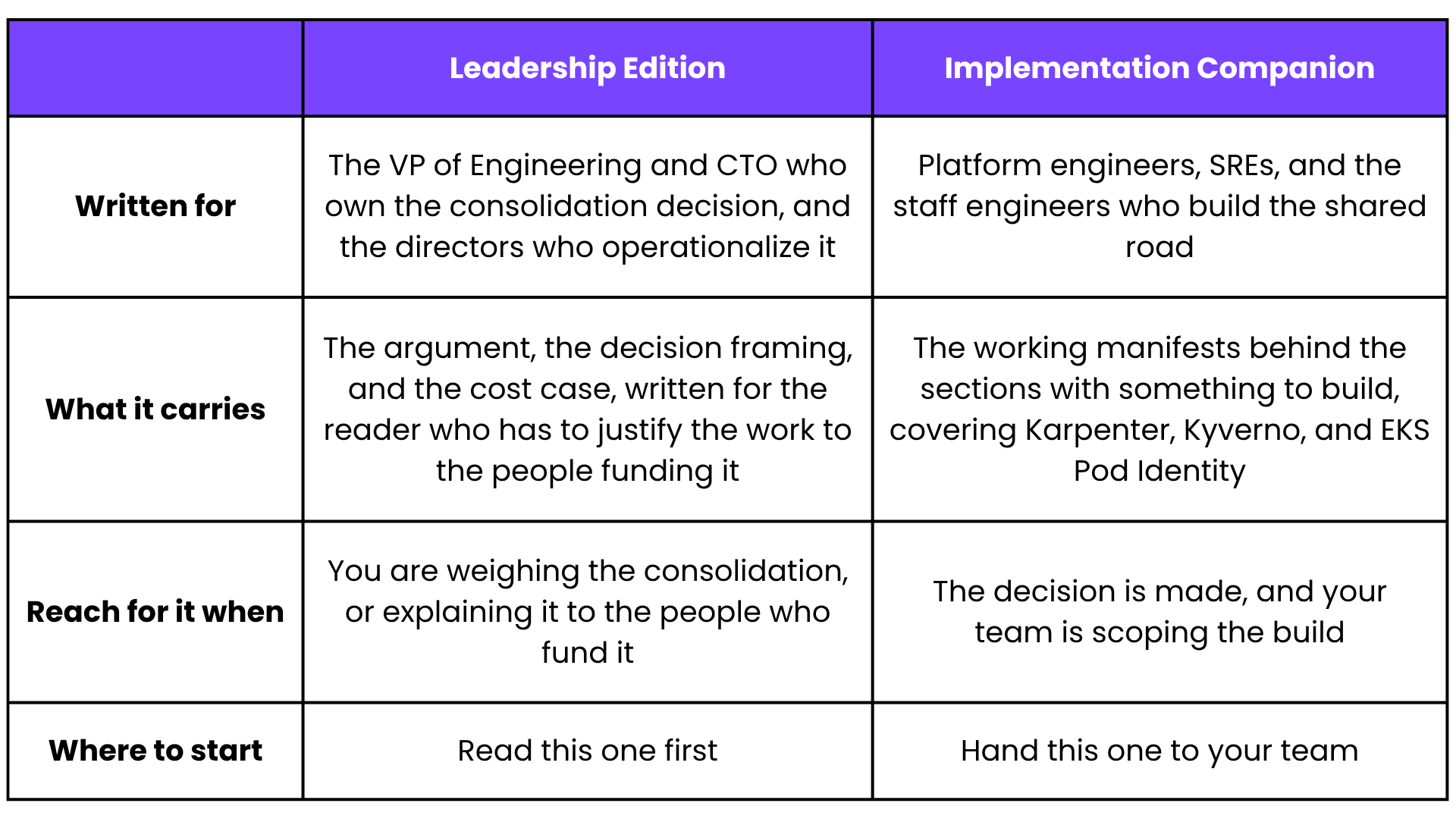
If you are forwarding one of these internally, the Leadership Edition is the one that travels. It gives a director the language to explain the decision upward and a second document to hand downward, so the request and the build arrive together.
Get The Paved Road Today
The Paved Road is available now, free, from a single form. You get the Leadership Edition, which includes the consolidation argument and decision framing, plus the Implementation Companion, which includes the manifests behind the build. Both documents include a grounding and sources appendix. Vendor-sourced figures are flagged as directional, with the reasoning stated in the open, so you can weigh the evidence yourself.
Frequently Asked Questions
What is The Paved Road?
The Paved Road is a free two-part field guide to the platform consolidation decision, published by EverOps. The Leadership Edition covers the decision and the argument behind it. The Implementation Companion carries the manifests for the build. Both are available in a single download at no cost.
Which edition should I read first?
Start with the Leadership Edition if you own or influence the consolidation decision. It carries the reasoning and the framing you will need to explain the work to the people funding it. Start with the Implementation Companion if the decision is already made and you are scoping the build.
Do I need both editions?
Most readers use both, in different ways. Leaders read the Leadership Edition and forward the Companion to their platform team. The matching section numbers let the two groups have one conversation.
Is this only useful for teams running EKS?
The recurring scenario is an EKS estate, and the Companion manifests are written for that environment. The reasoning in the Leadership Edition applies to any fragmented estate heading toward a shared internal platform.
Does this also apply to smaller estates?
Yes. The fifteen-cluster scenario reflects the kind of environment platform teams inherit constantly, and it makes the material concrete. The question the guides ask holds at any size, aiming to answer whether the shared path is the one your engineers actually take.
Do the guides assume we have already decided to consolidate?
No. The Leadership Edition is written for the decision itself, including the case for keeping some boundaries in place. Consolidation carries real costs, and the guide names them openly.
Are the guides really free?
Yes. One form gives you both editions at no cost. We are not holding anything back for a paid version.
Where do the figures come from?
Both editions close on a grounding and sources appendix listing the primary and industry sources behind the load-bearing claims. Where a figure comes from a vendor with a product to sell, the guides say so and treat the number as directional.